
Plan flows (the plan package)
The plan package builds plan flows: a Go-embedded builder you author as typed handles, compiled to the same journal-backed runtime as plain Go. It adds a way to author, never a way to execute. Every node lowers to a memoized journal step (Journal.Step), so a flow inherits at-most-once side effects, halt-on-ambiguity, and durable resume for free, and it can be checked against its declared shape (conformance).
Requires Go 1.27 (the builder uses generic methods).
When to reach for it
Plain Go plus the durable primitives (durable steps) already gives you the guarantees and full type safety. Reach for plan when you want the flow to be a value: a declared topology you can render, diff, version, hand to a visual builder, and, above all, prove a run followed (did the run do what the diagram said?). If you do not need a declared topology, plain Go is simpler and wins on every other axis.
A flow, end to end
import (
    "github.com/bide-ai/bide/agent"
    "github.com/bide-ai/bide/plan"
)

f := plan.New[Order, Receipt]("triage")                  // input and output pinned here

classify := f.Step("classify", classifyOrder)            // func(context.Context, Order) (Assessment, error)
reserve  := f.Step("reserve", reserveInventory)          // Assessment -> Reservation (a non-idempotent effect)
finalize := f.Step("finalize", finalizeReceipt)          // Reservation -> Receipt
decline  := f.Step("decline", declineReceipt)            // Assessment -> Receipt

f.Switch(classify,                                       // route on classify's output
    plan.When(func(a Assessment) bool { return a.Rush }, reserve),
    plan.Else(decline),
)
f.Edge(reserve, finalize)

flow, err := f.Build()                                   // validates the whole graph; returns *plan.Flow
if err != nil {
    return err
}

out, err := flow.Run(ctx, journal, runID, order)           // Order in, Receipt out
journal is an *agent.Journal over any store (an in-memory store for tests; store/sqlite or store/postgres for production). runID is the durable identity: re-running the same runID resumes from the journal.
The pieces
New[In, Out](name)pins the flow's input and output types at construction, so the boundary is checked there rather than by an afterthought.- Nodes are builder methods that return a typed
Handle:Step[I, O](name, func(context.Context, I) (O, error))wraps arbitrary Go.IandOare inferred from the func. The body receives the ctx the step runs under, derived from the one passed toRun: it carries the caller's cancellation, deadline and values, so a long body should stop whenctxis done (returnctx.Err()orcontext.Cause(ctx)). A body that returns an error records no result, so on resume a default step halts on its attempt marker (*agent.OutcomeUnknown) and aReadOnly/Idempotentstep runs again. A default step must not pause: a body that returns a pause (anInterrupt, a pending approval) isErrConfig, as forJournal.Step; put the pause in aReadOnlystep of its own.Join2/Join3merge bodies take the same leadingctx.Whenpredicates andSwitchrouting take no ctx: they must be pure functions of the value, since resume replays the recorded arm.Tool[I, O](name, agent.Tool)runs a tool; giveI/Oexplicitly (they say how to JSON-encode the input and decode the result). The node runs the tool as an agent does: under itsToolSpec.Timeout(agent.WithTimeout), where a result that arrives after the deadline is returned and an error after it, while the flow's own context is live, has an unknown outcome (agent.ErrToolOutcomeUnknown: a side-effect node halts on its next drive, a retry-safe node runs again); and only once the call guard admits it, so a flow run under anaudit.AttenuatingSubAgentdelegation whose grant has expired fails the node without calling the tool.Build(andRegisterTool, reported again atLoad) refuses a toolagent.Newwould refuse for how it wraps another.Model[I, O](name, prompt)is a model turn: bind a model withBuilder.WithModel(m)(or, in a declarative config,Load'sWithLoadedModel). The node renderspromptas atext/templateover the typed inputI, calls the bound model, and decodes the structured response intoO(soOmust be JSON-shaped). A model that honours a response format (agent.ModelInfoOfreportsResponseFormat:model/openai,model/gemini) is sentO's JSON schema as the provider's structured output, so it answers withO's JSON, each field of its schema type, with no prose or code fence. Any other model (model/anthropic, or one that does not describe itself) is sent no schema, so the prompt should still name the fields and their types. Build errors if aModelnode has no bound model, naming it. AModelnode isReadOnlyby default: it calls no tool and changes nothing outside the run, so a call whose outcome is unknown (a crash lost its result, or the call failed: the provider errored or the reply did not decode intoO) is made again on the next drive instead of halting. A re-call costs tokens and may answer differently; nothing saw the lost answer. A configsafety: side_effecton the node halts instead.- The string
namenames the node's durable journal key,node:<name>: it must be non-empty, unique, and contain no:(Build enforces all three; Run derives its keys, such asnode:<name>andswitch:<name>, with:), and stable across code edits, because resume finds a node by this name. It is not just a label.
- Wiring takes handles, so a miswired connection does not compile:
Edge[M](from, to)connects a producer to a consumer, unifying the connecting typeM.Switch[M](over, When(pred, to)..., Else(to))routes on a node's output to exactly one arm. Switch arms do not reconverge (each arm runs to a terminal producingOut); useJoin2/Join3for fan-in of branches that both run, and aLoopBack(max, pred, head)arm (awhenarm withloop_maxin a config) for a bounded loop.
Build()validates whole-graph coherence (entry consumesIn, every terminal path producesOut, names unique, no unreachable node, at most oneElseper switch) and freezes the spec into a*Flow. Errors name the offending node.Run(ctx, store, runID, in)drives the flow sequentially on the runtime and returns the typed output. It adds no executor.RenderMermaid()renders the declared topology (contrastagent.RenderMermaid, which renders the actual-ran path from the journal). A gated node's label carries its gate:approval: 2 of 3 (ops, finance, risk), excluding the requester, times out after 24h.Conform(ctx, store, runID)checks a run's journal against the declared topology and returns whether it followed the graph (ok), the divergences, and an error.
What you get, and the semantics to know
Every node runs as a Journal.Step under its node key, so it has exactly a Step's guarantees:
- At-most-once with halt, automatic. Before a default node's body runs, its Step claims the attempt marker
attempt:step:node:<name>; after the body succeeds, it journals the resultnode:<name>. On resume: a recorded result replays (the body does not re-run, and the node costs one point read); an attempt with no result means the outcome is unknown, soRunhalts with an*agent.OutcomeUnknownrather than re-firing the body. ASwitchchoice is journaled as its own recordswitch:<over>and replayed, so a resumed run takes the branch it originally took; predicates must therefore be pure functions of the node's output. - A halt is a Step halt. Its
Opisagent.OpRef{Kind: agent.OpStep, ID: "node:<name>"}(or"node:iter:<n>:<name>"inside a loop), and it is a pause (agent.IsPause), soRecoverLooptreats it as waiting, not failed. Once you know the node's true outcome, record it withflow.ResolveHalt(ctx, store, halt.Ref(), agent.Outcome{Result: output}), whereoutputis the node's output value; the nextRuncontinues past the node without running its body, feedingoutputdownstream.flow.ResolveHaltisagent.ResolveHaltafter three checks against the flow: the halt names a node of this flow, the run is a run of this flow (its recorded start names the flow and its recorded digest is the flow's), andoutputdecodes as the node's output type (a resolution is final, so one the flow could not read would leave the run unable to continue). Likeagent.ResolveHalt, it resolves only a node that halted: one with a live attempt marker (agent.ErrNoLiveAttemptotherwise). - A cancelled flow stops at its next node.
agent.Cancel(ctx, j, runID, reason)of a flow's run writesrun:cancelled. A node reads it once it will run (after a side-effect node's claim is won, recording the attempt as not started), so no node starts afterCancelreturns; a node already running finishes. The flow then returnsagent.ErrRunCancelled, and so does every laterRun. A flow that completed whileCancellanded reads its end markers back: the first in journal order is its end, asagent.Statusreports it. - A node that provably never started is re-attempted. A driver cancelled (or whose store failed) after claiming a node's marker and before calling its body records that the attempt did not start, and the next
Runre-attempts the node under a numbered marker (attempt:retry:<n>:step:node:<name>) instead of halting. A process that dies in that gap records nothing, so its resume halts, which is safe. - Halt is per node, and conservative by default. Because the attempt marker is written before the body, any crash inside a node halts on resume unless the node is classified safe to repeat. The default (no classification) never double-fires, but completing after a mid-node crash then requires resolving the halt. A node may instead declare a
Safety(read-only or idempotent, viaReadOnly()/Idempotent()in Go) so it writes no marker and re-runs on resume instead of halting. AModelnode is read-only unless a config lowers it. A declarative config'ssafetymay only lower that (see "Node and join safety").Safetyis not part of the digest, so a node may be relabelled between a crash and its resume: the marker is the attempt's recorded safety, so a node attempted as a side effect halts even if it is retry-safe now, and a node attempted as retry-safe (no marker) runs again under a claim if it is a side effect now. - A run keeps its flow and its input.
Runchecks the run ID asagent.Rundoes (an empty ID, or one in the form reserved for sub-agents and session turns, isErrConfig), then records the run's start (run:start, seeagent.RunStart): kindagent.RunKindFlow, the flow's name, and the JSON of the input. A later drive with a different input, under another flow's name, or of a run anAgentstarted isErrConfigand records nothing (and anAgentrefuses a flow's run the same way). Inputs are compared as canonical JSON (keys sorted, each number as the exact decimal value it denotes, so1,1.0and1e0match and2^53and2^53+1do not), so the recovery path of decodingRecordedStart'sInputwithout loss (into the flow's input type, or withjson.Decoder.UseNumber) and passing it toRunresumes the run even where that round trip changes the JSON text. Decoding it into afloat64can change a number, and then the input. The comparison is blind to whitespace, key order, a number's spelling (whatever the size of its exponent) and a string's escaping, and nothing else: an input whose JSON has a repeated object key, an escaped lone surrogate ("\ud800") or invalid UTF-8, on which two different texts would read as one value, is refused withErrConfigbefore anything is recorded. Like RFC 8785, the comparison reads numbers as values:-0is0, and1.0is1. A resumed drive whose input differs from the recorded one only that way is the same input, and its nodes see the input the run recorded (their recorded outputs are replayed); a flow whose input type isjson.RawMessage, or that relies on the sign of zero, should not resume with such a respelling. The comparison takes time linear in the input's length, whatever its nesting or the size of its exponents.Runthen records the flow's digest and, on resume, refuses (ErrConfig) to continue a run that started under a different digest: its journal only means what it meant under that flow. - A finished run is final. When the terminal node finishes,
Runrecordsrun:completewith the flow's name and its output, soRecoverandRecoverLoopskip the run andagent.IsCompletereports it. A later drive with the run's input returns the recorded output with one point read, whatever the flow's topology is now. - Steps inside a node are scoped to it. A
Journal.Step(orJournal.Paralleltask) a node's body runs for the same run ID is recorded under the node's key,node:<name>:step:<step>(andnode:iter:<n>:<name>:step:<step>in a loop body), so each loop iteration runs its own Steps instead of replaying the first iteration's, and a Step name need be unique only within its node (and must not be empty: an empty name isErrConfig, for everyJournal.Step). A halt of such a Step names that key; resolve it with the halt'sRef(). Other pauses a body takes (Interrupt,Await) are not scoped: give them names unique per iteration. - Durable timers are not available in a node.
agent.Sleepandagent.WaitUntilneed the run context an agent gives its tools, which a flow does not bind: called from aSteporToolnode they fail withErrConfig("agent: Sleep called outside a running agent"). A run that must sleep and wake needs an agent run today: see the ambient agent recipe and durable timers. - A node can wait for human approval. A node gated with
plan.Approval(policy)(or by the agent tool it wraps, or a configapprovalblock) pauses before it runs, exactly as a gated agent tool call does: see Approval gates on nodes. - Reserved keys.
node:,switch:andflow:are reserved prefixes, likerun:andattempt:, so aJournal.Stepa node's body runs cannot name one of the flow's records. - Conformance. Because the flow is authored and the actual path is derived from the journal, a run can be proven to have followed the declared topology, at node-visitation granularity plus the journaled branch choice.
Conformreplays the run's routing from its recorded choices: a record of a node on an arm itsSwitchdid not take, of a loop iteration the run did not reach, or of a node inside or outside a loop under the wrong kind of key is a divergence, and so is a journal that records nodes withoutrun:startandflow:digest. A completed run must record every node, choice and loop iteration its routing reaches (Runrecords them all before its completion), and itsrun:completemust carry the recorded output of the last terminal node it reached. Values are compared under the one rule above, so an output recorded with or without HTML escapes (\u003cor<) is the same output. The blind spot: conformance sees that a node ran, not what its Go body did inside, so a node whose interior must be checked should be split into smaller nodes.
Approval gates on nodes
A node can require human approval before it runs, with the same gate an agent's tool call uses (Human approval): agent.SingleApproval() for one decision, or an m-of-n policy of named approvers who sign their decisions. Gate a node with plan.Approval, and give the flow the approvers' verifiers:
b := plan.New[Order, Receipt]("refunds").WithApproverVerifiers(approvers)
lookup := b.Step("lookup", lookupRefund, plan.ReadOnly())
refund := b.Step("refund", issueRefund,
	plan.Approval(&agent.ApprovalPolicy{Need: 2, Approvers: []string{"ops", "finance", "risk"}}))
b.Edge(lookup, refund)
Run returns *agent.ApprovalPending before the node runs. Its ToolUseID is the node's key (node:refund, or node:iter:<n>:refund in a loop body), its ToolName the node's name, and its Args the node's input as JSON: what approvers sign. Record decisions as for a tool call, then run again with the same input:
var pend *agent.ApprovalPending
if errors.As(err, &pend) {
	// each approver signs agent.ApprovalDecisionBytes(pend.Subject(), id, approved, decidedAt)
	if err := agent.SubmitDecision(ctx, j, agent.Decision{RunID: pend.RunID, ToolUseID: pend.ToolUseID,
		ApproverID: "ops", Approved: true, DecidedAt: decidedAt, Alg: audit.AlgEd25519, Signature: sig}); err != nil {
		return err
	}
}
out, err := flow.Run(ctx, j, runID, in) // runs the node once 2 of 3 have approved
The same records and rule. The gate records the request (
approval-request:<node key>, the node and its input) the first time it is reached, counts decisions withagent.TallyApprovals, and records its terminal tally (approval-tally:<node key>) before the node runs.Decisions follow the request. Node keys are predictable, so a decision counts only if it is recorded after the gate's request, and its signature must verify over the input the request records: an approver decides on the node's actual input.
agent.Approveandagent.SubmitDecisionrefuse (ErrConfig) a decision on a node key whose gate has recorded no request yet; in a loop, each iteration's key gets its request when that iteration reaches the gate. (This applies to a flow's runs; an agent's tool call keeps its rules whatever its ID looks like.) A decision written into the journal before the request by other means never counts. For aSingleApprovalgate it holds the decision's first name, soApproverecords the real decision under the gate's second name, which the gate honours: the stale record does not block the gate. For an m-of-n gate the approver signs again at a new time (a newDecidedAt): that is a new decision, recorded after the request, and it counts; resubmitting the identical stale decision returnsErrConfigsaying so. ASingleApprovalgate is decided withagent.Approve(ctx, j, pend.RunID, pend.ToolUseID, ok).A denial stops the run. A gate whose quorum can no longer be reached (or an
Approve(false)) never runs the node:Runreturns an error wrappingplan.ErrApprovalDenied, and so does every later drive. Nothing is compensated (flows have no saga);agent.Cancelends the run.A deadline stops the wait. A gate with a timeout (
ApprovalPolicy.Timeout, ortimeout: 48hin a configapprovalblock) that has no approval by its deadline expires:Runreturnsplan.ErrApprovalExpired(which wrapsplan.ErrApprovalDenied), the node never runs, and every later drive returns the same. The deadline is measured from the gate's recorded request and recorded once (approval-deadline:<node key>); in a loop each iteration has its own. See Human approval.A pause survives a crash. Every fact the gate uses is in the journal; decisions recorded while no process runs the flow are counted by the next
Run, and a gate that passed is never asked again.In a loop, the gate is per iteration. Each iteration's run of a gated node pauses for its own decisions on its own input. To approve a whole loop once, gate a node before it.
A gate on an arm not taken never pauses.
Separation of duties. A policy with
ExcludePrincipalnever counts the run's requester (see Human approval). A flow run's requester is theOnBehalfOfof the identity it starts with (agent.WithIdentitypassed toRun, or the one its context carries inside an agent run), which the run journals in itsrun:principalandrun:start(a flow started inside another run's drive also records that run's principal chain, and runs its nodes start record the flow's); a later drive under another principal isErrConfig, and one with none runs under the journaled one. A flow run recorded with no principal (every flow run an earlier version started) keeps none, whatever a later drive carries, and stops at such a gate withErrConfig.goops := agent.WithIdentity(agent.Identity{OnBehalfOf: "ops"}) // from your auth layer out, err := flow.Run(ctx, j, runID, in, ops) // ops's own approval of a gated node never countsThe digest commits to the gate, so a paused run cannot be resumed under a flow whose gate was removed or changed. A node carries one gate:
plan.Approvalon aToolwhose agent tool declares another gate is aBuilderror.Buildrefuses an m-of-n gate in a flow with noWithApproverVerifiers(WithLoadedApproverVerifiersforLoad).Evidence.
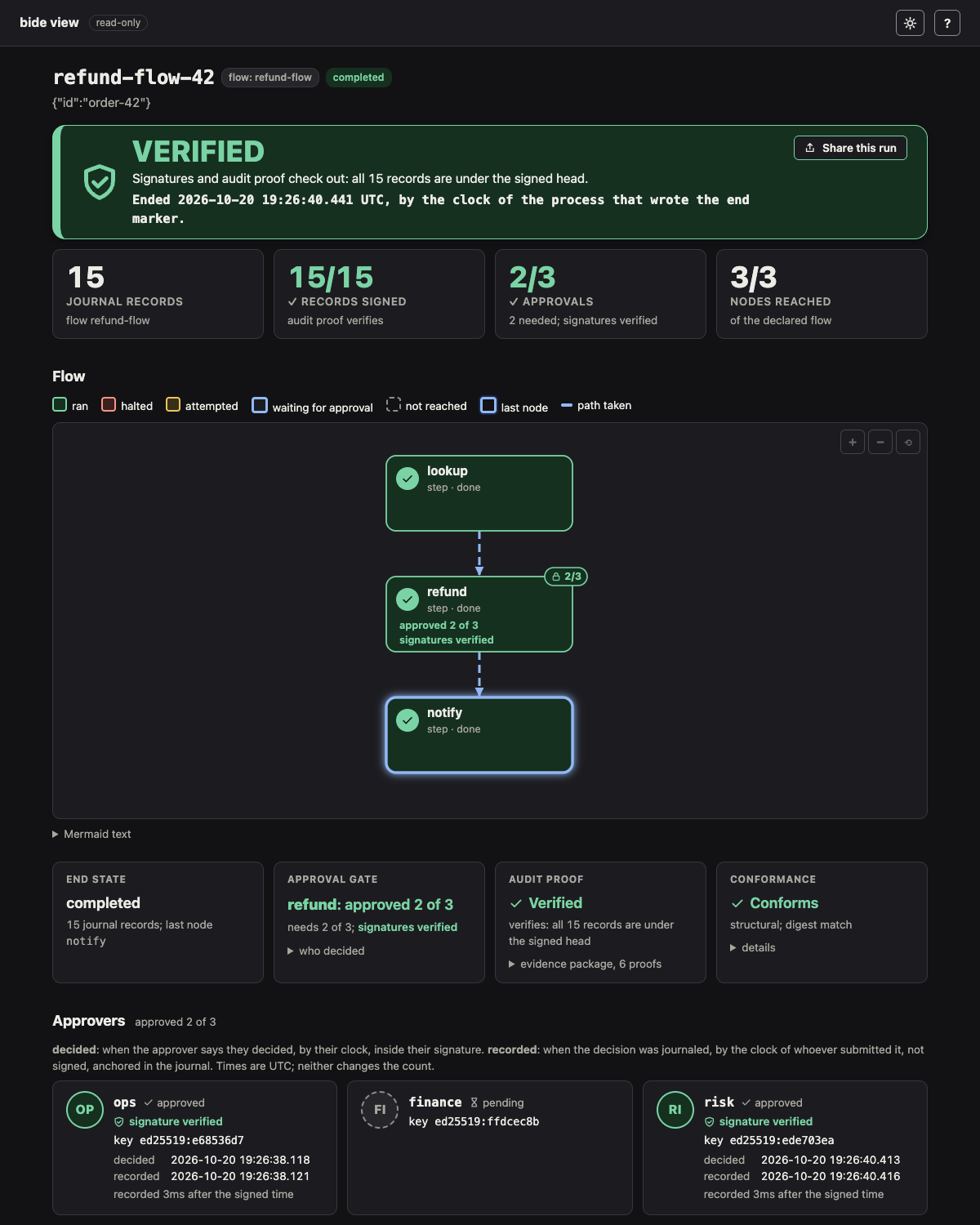
audit.ApprovalEvidence(ctx, j, runID, "node:refund", sth)andaudit.VerifyApprovals(orbide audit verify-approvals -call node:refund) prove offline that the approvers signed this node's input before it ran.bide viewshows the gate on the node.Tell a person. A paused gate, or a node that halts on an unknown outcome, stops the run until someone acts, and nothing tells them.
plan.New(...).WithNotifier(notifier, trail)(for a loaded flow,plan.WithLoadedNotifier) tells aagent.Notifieronce per event, at least once across crashes, with its delivery state on aNotifyTrailand not in the run's journal. It is a runtime binding, not part of the digest, and it takes the options ofagent.WithNotifier. Callflow.FlushNotifications(ctx)before the process exits to let deliveries in flight finish; a flow thatagent.Recoveroragent.RecoverLoopdrive is covered by the option given to them as well. See extension points.
examples/approval/flow runs the whole story from a config (its gate has timeout: 48h): the pause, two approvals, one refund, and the offline check.
Cryptographic conformance
Conform proves the run followed the declared graph against the same process's copy of the flow. Cryptographic conformance goes one step further: it makes that claim offline-verifiable by an auditor who never trusts your process, your database, or your logs. The property proven is precise: this run committed to THIS declared topology.
Two pieces make it work:
- A topology digest.
flow.Digest()returns a deterministic SHA-256 (hex) of the frozen spec: the flow name, each node's name, block, kind, input type and output type (types with their full package path, soa/model.Reqandb/model.Reqdiffer), every edge, and eachSwitchwith its ordered arms and their predicate names. It is computed by walking the insertion-ordered spec (never a map), so it is stable across builds and processes and changes whenever the flow changes (a renamed or retyped node, a node pointed at another block, an added or reordered edge, a changed arm or predicate). It commits to topology and to the names of the blocks and predicates it wires, not to the Go inside them.- A config node's block is the registered block it names (a join's is its merge block), and an arm's predicate is the registered predicate it names. In Go, a node's block is its own name unless
plan.BlockName("...")gives another, and an arm's predicate has a name only whenWhen(...).Named("...")(orLoopBack(...).Named) gives one. A Go flow that should share a config flow's digest gives the config's names. - This is digest v2 (
bide.plan.topology.v2).Runrefuses to resume a run whoseflow:digestwas recorded under v1, with anErrConfignaming v1, because v1 does not commit to block or predicate names and so cannot show the run started under this flow;Conformreports such a run as a divergence.flow.DigestV1()still computes the v1 digest, to check a proof of a record an earlier version journaled.
- A config node's block is the registered block it names (a join's is its merge block), and an arm's predicate is the registered predicate it names. In Go, a node's block is its own name unless
- A journaled record the audit layer covers. After the run's start and before any node,
Runrecords the digest, as a durable step under the reserved nameflow:digest(memoized on resume). Because it lives in the journal, theauditpackage's Merkle tree and signed tree head commit to it like any other record. - The topology itself, journaled beside it. Just before
flow:digest, a run's first drive records the declaredTopologyas JSON underflow:topology(plan.TopologyStep), one Insert, and a resume writes neither record again.plan.TopologyDigestof thatTopologyis the digest:Flow.Digestis computed through it, and theTopologycarries what the digest commits to beyond the drawing (each node's block, each arm's predicate name, and every type with its package path in the*_canonicalfields).plan.JournaledTopology(records)reads the record and checks its digest againstflow:digest, so a reader (such asbide view) can draw the flow a run ran from its journal alone and know the drawing is what ran.plan.InspectTopology(t)(v0.25.0) then reports thatTopologyasInspectConfigwould a config: its digest, its approval gates and which nodes every path passes through a gate (SafetyandAssertionsare nil, since a topology carries neither); it does not validate, so a dangling edge or a duplicate name is tolerated.bide edit -runuses it for its comparison with a run. The record is informational:Run, resume, routing and recovery do not read it. A run started before this record existed has none.
The flow, end to end:
flow.Run(ctx, store, runID, in)executes the flow. It journalsflow:digestbefore any node.audit.NewTreeHead(ctx, store, runID, ts)thenaudit.SignTreeHead(th, signer)(anyaudit.Signer) commit to the run's journal with a signed tree head (STH). Anchor the STH and its key in a separate trust domain; that is what makes it tamper-evident (see theauditpackage security model).audit.ProveRecord(ctx, store, runID, i, sth)builds an RFC 6962 inclusion proof for theflow:digestrecord (indexi), bundled with the STH.- An auditor holding only the bundle and the signer's public key (obtained out of band) checks
bundle.Verify(v)with a verifier for that key, which returns nil only if it holds (the STH signature is authentic and the record is included under the signed root), checks the STH's timestamp withaudit.CheckTimestamp, and that the proven digest equals the declared flow'sflow.Digest(). Together: the run committed to this signed diagram.
Conform closes the loop on the path: it recognizes run:start (which must name this flow), run:principal (which must name the principal and ancestors run:start does), a gate's tallies and re-tallies (approval-tally:<key>, :v3, :sod, and a certificate-bound gate's :ident and :ident-reask:<n>), its identity records, exec holds and notes (approval-identity:, approval-exec-hold:, approval-pause:), flow:digest, flow:topology (whose digest must be this flow's), a node's attempt markers and the not-started records of its claims as internal records (never a divergence) and verifies the journaled digest equals the current flow's Digest(). A mismatch is reported as a divergence, "ran against a different topology": the run executed under a different declared graph than the flow now describes. So Conform covers node-visitation and branch choices, and the digest + inclusion proof cover which topology the run committed to, verifiable offline.
The examples/plan demo prints this after a clean run (Cryptographic conformance: the run committed to the declared topology under the signed tree head), and TestCryptographicConformance there proves it in-process, including that a tampered flow:digest record no longer verifies under the signed root.
Declarative config
The builder authors a flow as typed Go. You can also author the same flow as data: a declarative config that describes the topology (nodes, edges, switch arms) and references behavior by name. A config places and wires nodes; it cannot write a Step's body or a Switch's predicate. Those stay in Go and are referenced by name through a registry. A config loads into the same builder and produces the same *Flow, so it inherits RenderMermaid, Conform, and the topology Digest unchanged.
The registry and Load
Registration maps config names to typed Go blocks, capturing each block's I/O types via reflect.TypeFor, so the config never restates types; they flow from the registered block.
reg := plan.NewRegistry()
reg.RegisterStep("classify", classifyOrder)              // infers Order -> Assessment
reg.RegisterStep("reserve", reserveInventory)            // Assessment -> Reservation
reg.RegisterStep("finalize", finalizeReceipt)            // Reservation -> Receipt
reg.RegisterStep("decline", declineReceipt)              // Assessment -> Receipt
reg.RegisterPredicate("rush", func(a Assessment) bool { return a.Rush })NewRegistry()returns a fresh, explicit, per-Loadregistry. There is no global mutable default, and a duplicate registration is an error, never a silent overwrite.RegisterStep[I, O]infersI/Ofrom afunc(context.Context, I) (O, error), the same shapeSteptakes;RegisterJoin2/RegisterJoin3take the merge shapes ofJoin2/Join3.RegisterTool[I, O]andRegisterModel[I, O]take them explicitly (anagent.Tooland a prompt carry no I/O types). AModelnode needs a bound model, supplied to the loaded flow viaLoad(..., WithLoadedModel(m)).RegisterPredicate[M]captures the switched typeM;RegisterJoin2/RegisterJoin3register a merge block for ajoin.
Loading supplies the boundary types at the Go call site (the caller knows them); the loader fills the middle from data:
flow, err := plan.Load[Order, Receipt](configBytes, reg) // *Flow[Order, Receipt], or a load errorLoadReader[In, Out] is the same reading from an io.Reader (an *os.File or an HTTP body). It reads at most 16 MiB and refuses a larger config with agent.ErrConfig.
The config schema
A config is pure topology plus block references: a required version (1, the only version this release reads, exported as plan.ConfigVersion), a top-level flow name, optional in/out documentation, an explicit entry (else nodes[0]), the nodes, and an ordered wiring list. Each wiring element is EITHER an edge {"edge": [from, to]} OR a switch {"switch": over, "when": [{"pred": p, "to": t}], "else": t}. An optional assert list states policy about the graph, which Load ignores (see Policy assertions). Every key is snake_case. Illustrative YAML:
version: 1
flow: order-triage
in: main.Order            # optional, cross-checked against Load's In
out: main.Receipt         # optional, cross-checked against Load's Out
entry: classify
nodes:
  - {name: classify, block: classify}
  - {name: reserve,  block: reserve}
  - {name: finalize, block: finalize}
  - {name: decline,  block: decline}
wiring:
  - switch: classify
    when: [{pred: rush, to: reserve}]
    else: decline
  - edge: [reserve, finalize]
The equivalent JSON (the loader format) is what examples/plan/declarative.go embeds and loads.
Fan-in: the join wiring element
A third wiring form fans several producers back into one node: {"join": name, "inputs": [...], "merge": mergeBlock}. The merge names a merge block registered with RegisterJoin2[A, B, O] (or RegisterJoin3), whose arity and input types Load checks against the join's declared inputs. As with steps and predicates, only the shape is data; the merge body stays registered Go referenced by name. A canonical fan-out-then-fan-in diamond as data:
nodes:
  - {name: split, block: split}   # int -> int, fans out
  - {name: y,     block: y}        # int -> int
  - {name: z,     block: z}        # int -> string
wiring:
  - edge: [split, y]
  - edge: [split, z]
  - join: merge
    inputs: [y, z]
    merge: mergeBlock              # RegisterJoin2(reg, "mergeBlock", func(context.Context, int, string) (string, error))
    safety: readonly               # optional; see "Node and join safety" below
The merge block:
reg.RegisterJoin2("mergeBlock", func(_ context.Context, a int, s string) (string, error) {
    return fmt.Sprintf("%s+%d", s, a), nil
})
Bounded loops: the loop_max back-edge arm
A switch when arm may carry a loop_max: {"pred": p, "to": head, "loop_max": n}. This is a bounded back-edge that routes to an ancestor of the switched node (the loop head) while pred holds, up to n iterations, so the graph stays finite. The arm's pred is an ordinary registered predicate referenced by name; loop_max is the only new field. A bounded countdown loop as data:
nodes:
  - {name: seed,   block: seed}     # int -> LoopState (entry)
  - {name: refine, block: refine}   # LoopState -> LoopState (the loop head)
  - {name: check,  block: check}    # LoopState -> LoopState (the loop switch)
  - {name: done,   block: done}     # LoopState -> string (the exit terminal)
wiring:
  - edge: [seed, refine]
  - edge: [refine, check]
  - switch: check
    when: [{pred: again, to: refine, loop_max: 10}]  # loop back to refine while N>0
    else: done                                        # exit
The same load-time validation Build gives a hand-built loop applies: the back-edge target must be an ancestor of the switch, the bound must be positive, and the routed type must equal the head's input type.
Node and join safety
A node (or a join) may carry a safety classifying how Run treats it on the ambiguous-crash window (its body ran, its result was lost to a crash): "readonly", "idempotent", or "side_effect" (one spelling per level; the pre-v1 alias "retryable" is refused, naming "idempotent"). A read-only or idempotent node re-runs its body on resume rather than halting, because its body is safe to repeat; a side effect halts.
safety and approval apply to a node, so they go on a node in nodes or on a join wiring element, which creates one. On an edge or a switch element there is no node, and Load, Validate and bide check refuse the key with ErrConfig naming the element, rather than accept it and drop it.
A config may only lower retry safety. Whether a step is safe to run twice is a property of its Go code, so only Go declares it: RegisterStep, RegisterTool (from the Safety in the tool's spec), RegisterModel, RegisterJoin2 and RegisterJoin3 take ReadOnly()/Idempotent() options (a Model block is read-only unless an option says otherwise; a Step, a Join and a Tool without a declared Safety are side effects). The levels, highest first, are read-only, idempotent (Idempotent), and side effect. A config safety may keep a block's level or name a lower one (mark a read-only block idempotent, or any block side_effect so a crash with no recorded outcome halts for confirmation), and a value above what Go declares (readonly or idempotent on a side effect, readonly on an idempotent block) is a load error (ErrConfig) naming the node. A config safety changes only the retry level: the approval gate the wrapped agent tool declares (its ToolSpec.Approval) is not part of Safety and is kept (see Node approval). The Go options ReadOnly() and Idempotent() on a Builder node are Go code and may raise a node's level; they too keep an approval gate.
nodes:
  - {name: read, block: read, safety: side_effect}   # halt on resume, even though Go declares it read-only
The join wiring element takes the same optional safety (shown in the diamond above), which may lower what its merge block's RegisterJoin2/RegisterJoin3 options declare.
Node approval
A node may also carry an approval block declaring an m-of-n human gate, which loads onto the node's approval gate (an agent.ApprovalPolicy, as agent.WithApproval sets on a tool) alongside any safety classification:
nodes:
  - name: refund
    block: refund
    safety: idempotent
    approval: {need: 2, approvers: [ops, finance, risk]}
Add exclude_principal: true to the block for separation of duties: the gate then never counts the run's requester (approval: {need: 2, approvers: [ops, finance, risk], exclude_principal: true}). It is part of the gate, so the flow's digest commits to it, and bide view -config -diff reports dropping it as a weakened gate.
bide view -config and RenderMermaid show both settings on the gate (excluding the requester, times out after 24h), and bide check -diff compares them: dropping exclude_principal, or removing or lengthening timeout, is a weakened gate (a run can wait longer, and a decision after the old deadline counts), and adding the exclusion or adding or shortening a timeout is a strengthened one. It also reports a weakening that is not a gate's own change: a node that every path reached through a gate before and some path now reaches without one, whatever its safety (as a new arm around a gated node causes), a new effect no gate guards, and a lowered safety (the label is the new config's own claim); a Switch condition changed beside an ungated effect (the predicates are not read, so it asks for a review); a block changed on an ungated effect node when checked without the Registry (the block's own gate is not visible); and an assert line removed or loosened. A node renamed with the same block, kind and edges is renamed, not a removal and an addition; a gate that changed with it is reported on it. See Compare two versions of a flow.
On a terminal, with the weakened gate first:

Load and Validate reject a block with no approvers, a need outside 1..len(approvers), or a duplicate approver id (or two that differ only by case), or an id that is not printable ASCII, naming the node. The gate is enforced as in Go (see Approval gates on nodes): load the flow with plan.WithLoadedApproverVerifiers(approvers), or Load refuses an m-of-n block (ErrConfig, naming the node). A join wiring element takes the same approval block. A block may restate the gate its registered block declares (a tool's own ToolSpec.Approval, or plan.Approval given at registration) but not replace it: a config cannot loosen a tool's gate. A block that declares a gate and a config that sets another is one problem, worded with its fix (keep one, by removing approval from the config or the gate from the block).
Policy assertions: the assert list
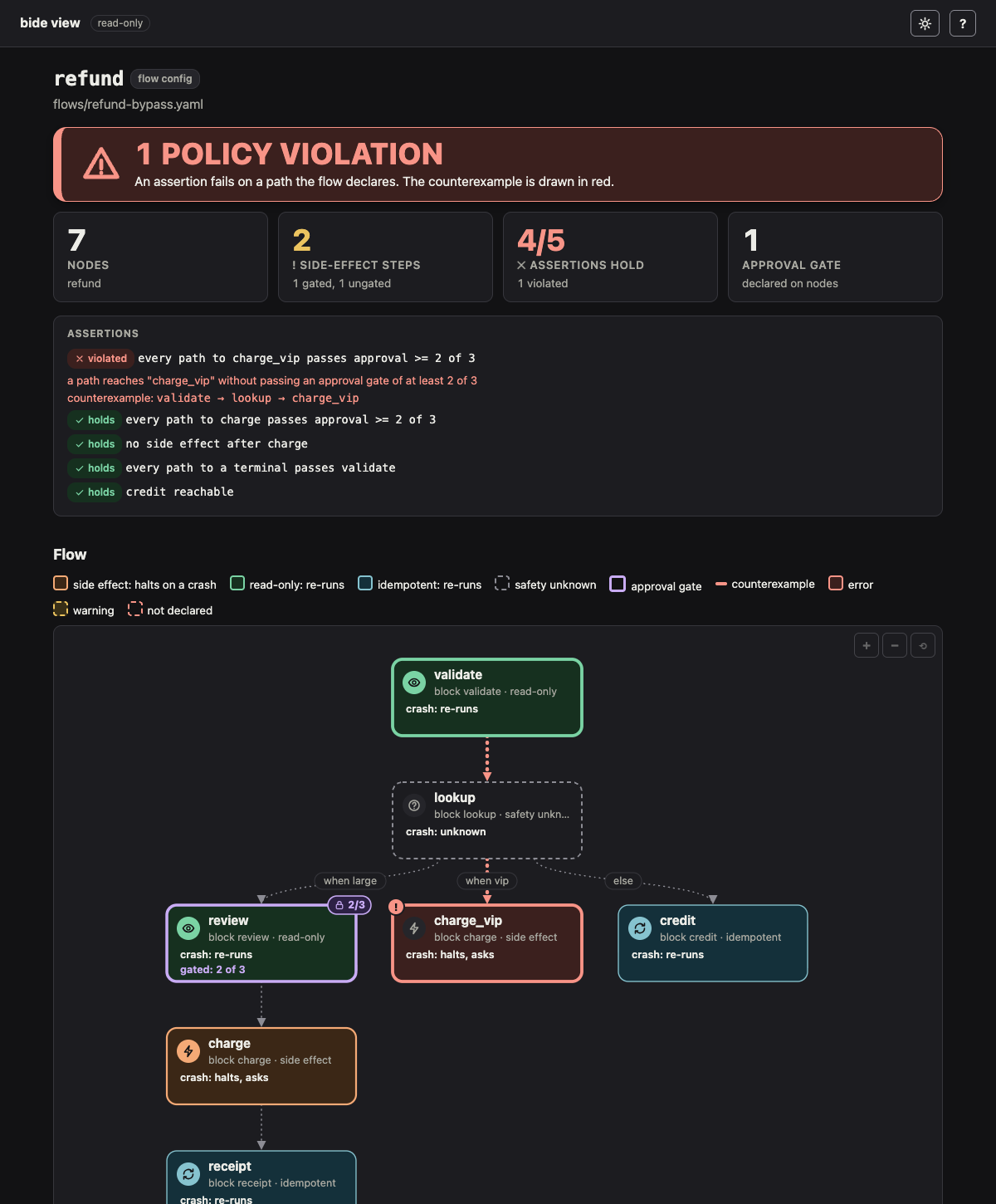
A config may state policy about its own graph in an assert list, one assertion per line. Load ignores the list (it is not part of the flow or its digest); bide check, bide view -config and plan.InspectConfig decide each line and report a violated one as an error, with a shortest counterexample path:
assert:
  - every path to charge passes approval >= 2 of 3
  - no side effect after charge
  - every path to a terminal passes validate
- credit reachable| Assertion | Holds when |
|---|---|
every path to <node> passes approval >= K [of N] [excluding the requester] | every path from the entry to the node passes a node whose approval gate needs at least K decisions (and, with of N, from at most N named approvers; and, with excluding the requester, never counts the run's requester: exclude_principal). The node's own gate counts. A one-decision gate (agent.SingleApproval) counts only for approval >= 1. |
every path to <node> passes <node> | every path from the entry to the first node passes the second. |
every path to a terminal passes <node> | every path from the entry to a terminal node (one with no outgoing edge or arm) passes the node. |
no side effect after <node> | no node a path from the node reaches is a side effect (a node that is in a loop with itself counts as after itself). |
<node> reachable | a path from the entry reaches the node. |
<node> unreachable | no path from the entry reaches the node. |
A node is named bare (no spaces) or in double quotes, and the words are separated by spaces. A quoted name is exactly what is between the quotes: there are no escapes, so a backslash is a backslash, and a name that contains a double quote cannot be written. Before this was so, a quoted name was unescaped as a Go string; bide check warns on a quoted name with a backslash sequence that the old reading would have changed (write the character itself). Every assertion is decided by reachability over the declared graph (every edge, a join's inputs, and every Switch arm, loop-back arms included), never by listing paths, so a loop is visited once. The graph is what the config declares: a Switch arm counts as taken whatever its predicate.
Gates and safety come from the same place the check does. With your Registry (plan/planview), a gate or a Safety a block declares in Go counts. From the command line, only the gates and safety values the config states count, so a gate declared only in Go reads as missing (the assertion fails, it never passes wrongly), and no side effect after X with a node of unknown safety after X (and no known side effect) is undecided, which is also an error. An assertion outside the grammar, or one that names a node the config does not declare, is an error too.
An every path to X passes ... or no side effect after X assertion holds vacuously when the entry reaches no X (or, for every path to a terminal passes X, no terminal: a flow whose every node has an outgoing edge, a cycle, has none). The check still reports it as holding, with vacuous set on the result and a message saying so; bide view -config shows holds vacuously, and bide check -diff reports a line that held and now holds only vacuously as weakened.
Editor support: a JSON Schema for flow configs
A JSON Schema (Draft 2020-12) describes the config, so an editor can complete keys, show each key's description on hover and flag a misspelled key, a wrong safety value, an element that is not exactly one of edge, switch or join, and an assert line outside the grammar as you type. It lives at plan/schema/flow.schema.json and its $id is the raw URL https://raw.githubusercontent.com/bide-ai/bide/main/plan/schema/flow.schema.json. Replace main with a release tag to pin the schema to a version.
The schema checks the shape of the file. Whether a block, predicate or node name exists, the types, and whether an assertion holds are still decided by Load, bide check and bide view -config.
YAML (VS Code with the Red Hat YAML extension, and other editors that run yaml-language-server). Put this comment on the first line of the config:
# yaml-language-server: $schema=https://raw.githubusercontent.com/bide-ai/bide/main/plan/schema/flow.schema.json
version: 1
To cover every config in a project without touching each file, map the schema to file patterns in .vscode/settings.json:
{
  "yaml.schemas": {
    "https://raw.githubusercontent.com/bide-ai/bide/main/plan/schema/flow.schema.json": [
      "flow.yaml",
      "flows/*.yaml"
    ]
  }
}
A JSON config cannot carry a "$schema" key (it is not a config key, and Load refuses it), so map JSON files with the json.schemas setting (the same URL and fileMatch patterns) instead.
JetBrains IDEs do not read the comment. Open Settings, Languages & Frameworks, Schemas and DTDs, JSON Schema Mappings, add the schema by URL (or the local flow.schema.json) and map it to your config files.
A YAML plain scalar cannot start with a double quote, so an assertion that quotes a node name with a space in it is written as a single-quoted string: '"send receipt" reachable'.
The schema is kept in step with the code by a test (plan/schema_test.go): every key Load decodes is in the schema and no other is, its enums and assertion patterns are the code's own, and every config in examples/plan/flows is valid under it.
Load-time validation
To see a config's graph and its problems before loading it, run bide view -config flow.yaml (-check for CI), or embed the same page with your Registry through package plan/planview; see the run viewer guide, or bide edit flow.yaml for the same check with an outline and an inspector (the flow editor guide). All use plan.InspectConfig, which reports the checks below as problems attached to the node, edge or arm they name.
Moving topology from Go to data trades compile-time type checking for load-time validation: a miswired config does not fail at go build, it fails at Load, with a worded error that names the offending nodes and types. The JSON is read as written: a name that is not a config field (a misspelling such as aproval, or a case variant such as Safety), a name given twice, and data after the value are parse errors, so a typo cannot silently drop a gate or an entry. A config that omits version, or states a version other than 1, is refused, since the keys a config may use depend on its version. A key whose snake_case spelling is a key at that place (the pre-v1 loopMax, or Safety) is refused with an error naming the key to write and where it is, for example $.wiring[2].when[0]: "loopMax" is not a config key; version 1 keys are snake_case, write "loop_max". A name that is not printable is refused too: every identifier a reviewer reads (the flow, entry, in and out, node names and blocks, the references in edges, switches, arms and else, join names, inputs and merges, and the assert lines) must print. It holds no control character, no invisible or direction-changing character (a zero-width space, a zero-width joiner or non-joiner, a left-to-right or right-to-left mark, U+202E), no space other than a plain one, no private-use or unassigned code point, no character that a renderer may draw as nothing (every character with the Unicode property Default_Ignorable_Code_Point, which includes the Hangul and Khmer fillers, the grapheme joiner, the Mongolian selectors and every variation selector, and the Braille blank), no combining mark with no character before it to combine with, and no space at either end (the words of an assert line may be separated by any whitespace, as the grammar reads them). Such a name can read as another in a diff or a review; the error names the field and writes the character out, for example nodes[2].name "ch\u{202E}gra" holds a character that does not print (U+202E). This also refuses some legitimate text, on purpose: a Persian or Urdu word spelled with a zero-width non-joiner, an Indic conjunct spelled with a zero-width joiner, an emoji sequence joined by one (a family, a rainbow flag), an emoji with a variation selector (a red heart as U+2764 U+FE0F, a check mark, a keycap such as 1 with U+FE0F U+20E3; the bare symbol is a valid name), and a left-to-right or right-to-left mark in a name that mixes scripts and digits. The reason is that two names differing only by an invisible character read the same and one can impersonate the other. The way out is to transliterate the name, or spell it without the joiner, selector or mark. The Default_Ignorable set is taken from the Unicode tables of the Go toolchain that built the program (Unicode 17.0.0 for Go 1.27); a rule that allows a joiner only where a script needs it, as IDNA does, may come later. Approver ids are held to printable ASCII by the gate itself. bide check, bide check -diff, bide view and every page and error message the viewer serves write any such character that reaches their output (a file name, a journal's topology, a step or predicate name) as \u{XXXX}; the JSON endpoints and the other commands (bide edit's own messages, bide init) are not filtered. Every parse error wraps ErrConfig. Load then runs, by reflect.Type identity:
- Predicate typing: every switch arm's registered predicate
Mequals the switched node's output type. This is a strict improvement over the Go builder, which only checks a predicate at its compile-time call site. - Edge typing: every edge's
from.outTypeequalsto.inTypeexactly (nominal identity, not assignability, matching the Go builder'sEdge[M]). - Boundary typing: the entry consumes
In, every terminal producesOut, and any presentin/outdocumentation matchesIn/Out. - Join typing: a
join'smergeblock must be registered, and its arity and input types must match the join's declaredinputs; an unknown or mis-arity merge is a load error naming the join. A join is entered only by its inputs: anedgeinto it from any other node, a repeated input edge, or aswitcharm routing to it is a load error, since the merge would drop that value. A join's inputs are registered in wiring order, so an input that is itself a join must be defined earlier inwiring[](which also rules out a cycle of joins).bide checkandbide view -configreport this without a Registry, and so a reference to a join (an edge out of it, a switch over it) before its element, an edge, arm orelseinto a join, a node that is switched over and has an edge out, and two switches over one node. - Loops: an arm with
loop_maxabove 0 is a bounded back-edge to an earlier loop head. The head must reach the switch in the forward graph (the edges, a join's inputs and the arms that do not loop back), a switch has at most one loop-back arm, and it needs an exit (another arm or anelse). The loop's body is a simple region: no inner switch or nested loop, no edge that leaves it or enters it past its head, and no node between the head and the switch that is not on the loop path.bide checkandbide view -configreport all of these without a Registry. - The rest of the wiring: a cycle that is not a loop, a node not reached from the entry (an edge or an arm must lead to it: a node you have declared and not wired in yet is reported this way), a node fed by several producers (combine them with a join), and a join's inputs that sit on mutually exclusive arms of a switch or that a switch can skip.
bide checkandbide view -configreport these without a Registry, so what onlyplan.Loadwith your Registry can still refuse is what needs the Go side: a block, predicate or merge name that is not registered, the types, a merge block's arity and a node's own gate. - Structural checks
Builddoes not give: a node cannot be both switched-over and have an outgoing edge, and awiring[]element must set exactly one ofedge/switch/join.
Load reports all failures at once (collect-all drift): it names every unresolved block or predicate with a near-miss suggestion where one exists, and flags registered blocks the config never uses. It lists every type problem (every edge, arm, join input and terminal whose types do not fit), not the first, and InspectConfig reports up to 100 of them with a last line saying how many more there are; the errors of Load and Validate for these, and for the checks Build makes, wrap agent.ErrConfig. For CI, Validate(data, reg) error runs every check that does not need In/Out, so config-vs-registry drift is catchable in a unit test rather than only at process start.
Findings: the structure behind a problem
ConfigReport.Problems is for people: a message, and the node, edge or arm it belongs to. A tool that needs to tell problems apart (an editor deciding whether an edit added one, a CI step that counts type misfits) reads ConfigReport.Findings, one plan.Finding for each error in Problems:
r := plan.InspectConfig(data, reg)
for _, f := range r.Findings {
    switch f.Kind {
    case plan.ProblemEdgeTypes:
        // f.Names = [from, to]; f.Got is the type the producer gives, f.Want the one the consumer takes
    case plan.ProblemOther:
        // an error with no kind of its own: f.Message only
    }
}
A finding has a Kind, the Names it is about (in full, in the order the kind documents, with no position), Got and Want where the kind has them, and the Message of its problem. Two problems are the same problem when their kind, names, Got and Want are the same, not when their messages are: a message shortens a long name and names a wiring element by its position, so it changes when you move an element or rename a node.
| Kind | Names | Got, Want |
|---|---|---|
edge_types | from, to | type the producer gives, type the consumer takes |
arm_types | switched node, predicate, target | type the predicate tests, type the node gives |
join_input_types | join, input | type the input gives, type the merge takes there |
terminal_types | step | the step's type, the flow's output type |
safety_above_registration | node | safety the config states, safety the block registers |
loop_no_exit_arm, loop_more_than_one_back_arm | switch | |
loop_head_not_ancestor | switch, head | |
loop_body_not_simple | switch, node on the body that is not on the loop path | |
loop_inner_switch | node with its own switch, loop switch | |
loop_edge_leaves | from, to, loop switch | |
loop_edge_enters | from, to, loop switch, head | |
other |
The errors of Load and Validate carry no kinds, only messages (and agent.ErrConfig); a tool that wants kinds calls InspectConfig or InspectConfigDescribed. A problem's node, edge or arm (Node, From, To in Problems) is set where the problem is made, from its names, not read from its message.
Findings are in the Go API only: bide check prints messages and the pages bide view -config and bide edit serve do not carry findings in their JSON; a Go host that marshals a ConfigReport gets them.
Findings are found from the config and the registered types alone, so they are there beside any other error (a misspelt block does not hide a type misfit), and they are complete: where Problems lists the first hundred type problems and then "and N more", Findings has them all. Warnings have none. A config that does not parse has one other finding, its parse error.
Stability, while plan is 0.x: a kind's name, the order of its names and the format of Got and Want do not change; kinds are added (so ignore a kind you do not know); and other is a promise only that the problem is an error: any other may become a specific kind in any release, so treat other and an unknown kind alike. The messages behind other are listed in plan/testdata/other_findings.txt, which a test keeps current. Message is for people and may change.
Inherited for free, and conformable to its config
A config-loaded *Flow is an ordinary flow, so it inherits Run (sequential, at-most-once, halt-on-ambiguity), RenderMermaid (the declared topology, now sourced from the config), Conform, and Digest + the flow:digest record. Because the digest now commits to the config-derived topology, a signed tree head over the run proves offline that the run followed this config, the same way cryptographic conformance proves it followed the diagram. This is the headline: a config-loaded flow is cryptographically conformable to its config. examples/plan demonstrates it by asserting the config-loaded flow's Digest() equals the code-built flow's Digest(): the config and the Go describe the same topology (the Go names its predicate with .Named("rush") and the join's merge block with plan.BlockName("mergeBlock"), the names the config uses). The same holds for a config-built fan-in or bounded loop: examples/plan loads a join diamond and a loop_max loop, runs and conforms each, and asserts each config-loaded flow's Digest() equals its code-built counterpart, so a config-built join or loop is cryptographically conformable to its config just like the linear case.
JSON is the loader (and tool-emit / interchange) format; the core loader stays stdlib-JSON and dependency-free. YAML is a thin authoring front-end that decodes into the same config struct, not a core dependency, so the two formats are just front-ends to one loader.
A YAML config is one document. bide check, bide view -config and a bide init project refuse a file that holds a second one (a --- followed by more), as the JSON loader refuses data after the value; a leading --- and a closing ... are one document. Before this was checked, the second document was read by nothing and went unnoticed.
Describing a Registry
Registry.Describe returns a plan.RegistryDescription: what the program registered, as plain data. It lists each block with its kind (step, tool or model), input and output type names, the safety it declares and the approval gate it declares in Go; each predicate with the type it tests; each merge block with its ordered input types; and any registration errors Load would report. Type names are spelled as the topology digest spells them, with the package path. It holds no functions, prompts or schemas, it is sorted by name, and the same registrations give the same JSON, so a program can write it to a file for a tool to read. It is experimental: it may change in any 0.x release. The flow editor's typed mode is built on it.
Version 2 of the description also carries the taint declarations of each block and merge (untrusted, the sources, trusted, the reason, and taint_exempt, the reason) and a marker, taint_declared, that says so: with the marker, a block that lists none declares none. A Registry does not hold the flow's taint policy (that is Builder.WithTaintPolicy), so Describe leaves taint_policy empty; a host that has a policy sets it with plan.DescribeTaintPolicy(policy). An empty taint_policy means none was given to the description, not that the flow runs without one. A version 1 description (written by an earlier release) is still read; it has no marker and says nothing about taint, so a reader shows taint as not known, never as none. bide doctor -declarations and -diff read this description as a flow's declarations (see Reviewing the declarations).
plan.InspectConfigDescribed(data, description) checks a config against such a description, with the same code as InspectConfig, so a tool that has only the file (the flow editor's -blocks form) checks blocks, types, safety, gates and the digest without the program. RegistryDescription.Validate says why a description read from a file is refused. Two limits: types are told apart by name, so two distinct types spelled the same are one type (Load, comparing Go types, would refuse an edge between them, and the digest already cannot tell them apart), and a type is written with its package path in messages. A description is only as good as the program that wrote it; the check that holds is the one made with the real Registry. A registered block the config does not use is an error here, as in Load; a tool that lists blocks a config could use (the flow editor's palette) passes plan.AllowUnusedBlocks() to InspectConfig or InspectConfigDescribed so the blocks it has not placed yet do not hide the report of those it has. A process keeps one type for each distinct type name it has ever been given, so it admits at most 20000 names and 4 MiB of names in all (about 25 MB), and one description at most a quarter of that; past that the check reports an error and a long-lived host must restart to check new type names.
Taint in a check
plan.ConfigReport.Taint is the static taint verdict on each node: the may-version of the rule the engine will enforce (design: flow taint, sections 1 and 2). A node may read a declared source when the source runs before it in the engine's own order (the order Build and Run use), or when both are in one loop's body (the iterations after the first see the whole body, a node's own result included). Switch arms are all treated as live, so a node after an arm that is never taken still reads its source: an over-approximation. A verdict is one of reads untrusted, escalates (it can have a side effect, is not exempt and the policy has a Gate), refused (the same under Refuse), exempt, no declared source before it, or unknown. Sources lists the sources, Path a shortest edge path from a node that declares one, Declares what the node itself introduces (its block's sources and the config's untrusted key), and Reason what the verdict cannot know.
The policy is Go, not config: pass plan.InspectTaintPolicy(policy) to InspectConfig, or set TaintPolicy in the description InspectConfigDescribed reads (an explicit option wins). Without a policy a node that can have a side effect and reads a source is reads untrusted with the reason "taint policy not given": the view never says it escalates. plan.InspectTaintPolicy(agent.TaintPolicy{}), the zero policy, states that the flow has no policy: such a node is reads untrusted with the reason "no taint policy: nothing gates its side effect". A policy that is merely not given is never read as none. Without a Registry or a description that carries the declarations (version 2), every node is unknown and shows only the sources the config itself states; a report with errors has no Taint. What the view cannot see is stated in the verdict and never as a clean result: a source a block reads without declaring it, a run whose input is declared untrusted, and the taint of an agent or nested flow a block runs.
bide check prints the section (taint: 2 nodes may read untrusted data (1 escalates) and a line per node), or one line, taint: not known without -blocks (taint: not known (reason) when the blocks are given but declare no taint), and bide check -diff compares it: a node that can have a side effect and newly reads a source is listed when it is covered, that is the policy gates or refuses it, or it is exempt ("now reads inbound-email, escalates", "exempt (fixed amount)"); it is weakened (UNTRUSTED EXPOSURE WIDENED) when the policy is known to be absent, and the same for a node that read a source covered and is no longer covered. When the policy is not given on the new side the diff says the taint could not be compared and is not certified (like a diff with errors), whatever the old side gives. A node that no longer declares a source is weakened, and one that newly declares a source is listed as strengthened. A node's own approval gate does not cover this exposure.
Limits
- Fan-in is fixed-arity (
Join2/Join3); unbounded or ragged fan-in is not supported. Buildrejects wiring the runtime cannot execute as declared, naming the step: a step fed by more than one producer without a Join, more than one Switch over a step, a Switch and an Edge from the same step, a Switch inside a loop body other than the loop's own (so no nested loops), and an Edge that leaves a loop body or enters it past its head.Modeldecodes the response as JSON intoO, soOmust be JSON-shaped. Only a model that honours a response format is sentO's schema (structured output); for any other model the prompt should instruct JSON output, naming each field's type.- A flow can carry a taint policy (
Builder.WithTaintPolicy, experimental, Go only): a node that can have a side effect, run after the run has read untrusted content, needs an escalation gate onnode:<name>:taintor is refused; withSeparateApproversthe approvers its own gate counted do not count on that instance.bide checkandplan.InspectConfigshow the static view (ConfigReport.Taint, see Taint in a check). A plan node may carry a#in its name; its subject isnode:<name>, never an escalation instance. - A tool that carries amount caps (
agent.WithCaps) cannot be a flow block:Registry.RegisterToolandBuilder.Toolrefuse it withErrConfignaming the tool, because a node's gate path is separate from the agent's and would run the tool without the cap. A flow node that wraps an agent run keeps the agent's caps for that agent's own tool calls. - Requires Go 1.27.
A runnable example
examples/plan is a self-contained module: it builds an order-triage flow, prints the declared diagram, runs it against a sqlite-backed store, conforms the run, and proves cryptographic conformance (a signed tree head over the run plus an inclusion proof that the journaled topology digest equals flow.Digest()). Its cross-process test crashes mid-run and resumes in a fresh process, proving the side effect fires at most once and the run either completes or halts. Run the demo with cd examples/plan && GOWORK=off go run ..
Stopping a flow
Builder.WithStopSwitch (and plan.WithLoadedStopSwitch) gives a flow the process's kill switch, so a stop that covers the flow by name, a stop on the agent that acts, or a global stop holds a run as a pause (*agent.Stopped) at its start and each node before it begins. See the kill switch guide.