
Notifications: tell a person when a run needs them
A run that halts on an unknown outcome or waits at an approval gate stops until a person acts. The notifier tells that person. agent.WithNotifier raises the event and keeps the delivery record in an audited trail (see the design note for the guarantee); this page is about the shipped delivery, package notify: a signed HTTPS POST of a small JSON document, and the one-call check for the receiver. Set up, test and relay covers the bide notify commands that test a receiver and forward to Slack and PagerDuty.
import "github.com/bide-ai/bide/notify"The package is stdlib only.
Wire a webhook
hook, err := notify.NewWebhook(os.Getenv("BIDE_WEBHOOK_URL"),
	notify.WithSecrets(os.Getenv("BIDE_WEBHOOK_SECRET"), os.Getenv("BIDE_WEBHOOK_SECRET_PREVIOUS")),
	notify.WithTimeout(10*time.Second), // per request; this is the default
	notify.WithViewURL("https://bide.example.com/runs"), // optional: puts a view link in the payload
	notify.WithViewDB("/var/lib/orders/run.db"),         // optional: the journal the view command opens
)
if err != nil {
	return err
}

a, err := agent.New(model, journal, agent.WithNotifier(hook, audit.NewNotifyTrail(store)))
NewWebhook returns agent.ErrConfig for a URL that is not https (http is allowed only for localhost, 127.0.0.1 and [::1], for development) and for a missing secret. Secrets are arguments, read from your configuration or environment. They are never written to the journal, the trail or a payload, and never appear in an error.
Use at least 32 bytes of random data for a secret. Under GODEBUG=fips140=only, crypto/hmac refuses a key shorter than 14 bytes (112 bits) by panicking, so in that mode NewWebhook returns agent.ErrConfig (wrapping notify.ErrShortSecret) for a shorter secret, notify.Verify returns ErrShortSecret, and notify.Sign leaves such a secret out; without that mode any length is accepted, as before.
The same option goes to agent.RecoverLoop, which is what catches an event whose process died before the first record of it.
The error handler. agent.WithNotifyErrors(fn) receives the notifier's own failures: a delivery that has become failing, a trail error. fn may be called from several goroutines, and it is called while the round for that event is still in flight, so that FlushNotifications waits for it and a process that flushes and exits has delivered every report. So fn must be short (log, count, send the error to a channel), and it must not call FlushNotifications, RunNotifier.Flush or anything else that waits for the notifier to settle: that would wait for the round that is calling it. A flush from inside fn returns an error wrapping agent.ErrConfig at once instead of hanging. The error handler of agent.WithRecoverErrors is different: it runs after the failing run's slot is released.
The request
POST <url> with Content-Type: application/json and three headers:
| Header | Value |
|---|---|
Bide-Delivery | The notification ID, the same on every attempt of an event, and equal to the payload's id. The signature covers the body, not headers, so Verify requires this header to be present and equal to the signed id. Dedupe on the verified body id. |
Bide-Timestamp | Unix seconds when this request was sent. |
Bide-Signature | v1=<hex>, where hex is HMAC-SHA256 of Bide-Timestamp + "." + body under a secret. One v1= entry per secret, separated by spaces. |
The signature covers the timestamp, so a captured request cannot be replayed with a fresh one. It is always on, over every transport.
Delivery is at least once. The notifier core runs up to 3 calls per round with its own backoff, and each Notify call makes one request with a per-request timeout (10 s by default) that also honors the deadline the core gives the call. A 429 or 5xx with Retry-After is waited out (capped at 60 s, never past that deadline) before the call returns, so the next call does not arrive early. A caller that uses the webhook without the core can set notify.WithRequestsPerCall(3) for 1 s then 2 s of backoff between requests in one call. Network errors, timeouts, 429 and 5xx are retried; any other 4xx is an error wrapping agent.ErrNotifyPermanent, which ends the round (the core still tries again in a later round, since a receiver's configuration can change). Redirects are never followed: a signed body does not go anywhere you did not name. A response is accepted only when it is 2xx, so answer quickly and do the work after replying.
TLS is 1.2 at the minimum and 1.3 when the receiver offers it. Each delivery opens its own connection, so a rotated client certificate is used by the next delivery.
The environment's proxy settings (HTTPS_PROXY, NO_PROXY) apply, except when WithServerCA or WithServerPin is set: then the webhook connects directly unless you give notify.WithProxy. A proxy only tunnels the TLS session; certificates, pins and the client certificate are still checked against the receiver, but the proxy sees the receiver's address and timing.
Verify in your receiver
notify.Verify checks a request in one call:
http.HandleFunc("/bide", func(w http.ResponseWriter, r *http.Request) {
	if err := notify.Verify(r, secrets, 0); err != nil { // 0 means the 5 minute default tolerance
		http.Error(w, "unauthorized", http.StatusUnauthorized)
		return
	}
	var p notify.Payload
	if err := json.NewDecoder(r.Body).Decode(&p); err != nil { // Verify leaves the body readable
		http.Error(w, "bad request", http.StatusBadRequest)
		return
	}
	handle(p) // dedupe on p.ID, the signed delivery ID, first
	w.WriteHeader(http.StatusNoContent)
})
Verify reads the body (up to 1 MiB), recomputes the signature over the raw bytes, compares in constant time, and rejects a timestamp more than the tolerance from your clock, in either direction, and a Bide-Delivery header that is missing or is not the signed body's id (ErrDeliveryID). It computes one MAC per secret and looks at no more than 8 entries of the signature header, so a forged request costs the same however many entries it carries. If the body is larger than the limit it returns ErrBodyTooLarge, and r.Body still yields every byte. It returns one of ErrNoSignature, ErrBadTimestamp, ErrStale, ErrBadSignature, ErrDeliveryID, ErrNoSecrets or ErrBodyTooLarge; answer all of them with the same 4xx so a sender learns nothing about which check failed. A receiver in another language needs only the construction in the table above.
To check a stored delivery later, as evidence, use notify.VerifyBody with the stored headers and body and a tolerance wide enough for the delivery's age.
Rotating the secret
While you rotate, the webhook signs with two secrets and a receiver that has either one verifies:
- Deploy the sender with
WithSecrets(new, old). Requests now carry two signatures. - Update the receiver's secret list to
[new, old], then to[new]once step 1 is everywhere. - Drop
oldfrom the sender.
What is in the payload, and what is not
Schema bide.notification.v1:
{
  "schema": "bide.notification.v1",
  "id": "9f2c...e1",
  "key": "approval:orders-1042:call_01:0",
  "kind": "approval_pending",
  "run_id": "orders-1042",
  "event_at": "2026-10-13T09:14:05Z",
  "observed_at": "2026-10-13T09:14:07Z",
  "deadline_at": "2026-10-13T09:19:07Z",
  "attempt": 1,
  "summary": "Run orders-1042 is waiting for approval of tool refund (call call_01).",
  "step": { "op_kind": "tool", "op_id": "call_01", "tool": "refund" },
  "halt": null,
  "principal": { "on_behalf_of": "desk-7", "authority_ref": "" },
  "approval": {
    "tool_use_id": "call_01",
    "tool": "refund",
    "policy": { "need": 2, "of": 3 },
    "approvers": ["alice", "bob", "carol"],
    "approved": 0
  },
  "abort": null,
  "failing": null,
  "stop": null,
  "clears": null,
  "view": { "command": "bide view -db /var/lib/orders/run.db -run orders-1042", "url": null }
}
kind is outcome_unknown, approval_pending, approval_expired, run_aborted, recovery_failing, notification_overdue, resolved, escalated, stop_set or stop_lifted. approval_expired says that an approval gate's deadline (ApprovalPolicy.Timeout) passed with no approval, so the call will not run; it is sent when the pending approval's all-clear finds the expiry, whose reason is then expired (the other reasons: resolved, decided, ended, recovered), and it carries the gate's approval detail. stop_set and stop_lifted are the kill switch's events: a stop was set (it is ended by the usual all-clear, reason lifted), and a stop was lifted by the lift rule in force (a fact; an audited stop's partial lifts raise nothing). They carry stop: id, scope (global, tool, flow or agent) and name, the operator's reason (text: show it, never trust it), by and host (asserted in basic mode, authenticated by the signature when signed), mode, compensation, and for stop_lifted lifted_by; never a key, a signature or a secret. Their run_id is @stop, the kill switch's control run, and their view command is bide stop -db <db> -show <id>. At most one of halt, approval, abort, failing, stop and clears is set, as the kind says; an escalated notification carries the detail of the event it escalates and sets escalates (see Routing and escalation), and every payload names its receiver. summary is generated from the structured fields, so a chat message can post it as it is. notification_overdue, resolved and escalated also carry a reason. New fields are additive within v1 (clears and escalates are two; each is null on every other kind); ignore the ones you do not know.
The all-clear
When an event you were told of stops being current, a second notification closes it: kind is resolved (agent.NotificationResolved; agent.Notification.Clears for an in-process notifier), and clears names the event.
{
  "schema": "bide.notification.v1",
  "id": "41b7...c0",
  "key": "resolved:approval:orders-1042:call_01:0",
  "kind": "resolved",
  "run_id": "orders-1042",
  "event_at": "2026-10-13T09:31:40Z",
  "observed_at": "2026-10-13T09:31:41Z",
  "deadline_at": null,
  "attempt": 1,
  "summary": "Run orders-1042: the approval_pending event is over (decided). No action is needed for it.",
  "step": null,
  "halt": null,
  "principal": { "on_behalf_of": "desk-7", "authority_ref": "" },
  "approval": null,
  "abort": null,
  "failing": null,
  "clears": { "id": "9f2c...e1", "key": "approval:orders-1042:call_01:0", "kind": "approval_pending" },
  "reason": "decided",
  "view": { "command": "bide view -db /var/lib/orders/run.db -run orders-1042", "url": null }
}
reason is resolved (a halt was resolved), decided (a gate was decided), ended (the run ended) or recovered (recovery works again). event_at is when bide found the event no longer current, which is no earlier than when it ended; there is no deadline_at. The all-clear has an id of its own, delivered at least once and signed like any other, so dedupe on it as usual.
Matching it to the event. clears.id and clears.key are the id and key your receiver got for the event. Event keys are never reused and an event that stopped does not start again, so the clears.id is final: treat every delivery of that ID, before or after the all-clear, as superseded. Do not rely on the order of arrival. The all-clear can come first when the event's own delivery had failed, or its reply was lost, before the event stopped (the request may have landed, so the all-clear is sent). A receiver that keys incidents on the ID (PagerDuty's dedup_key) needs nothing more; a stateless relay may drop an all-clear for an ID it has never seen.
What does not get one. run_aborted, which is a fact and not a state; an event that stopped before bide tried to deliver it (nobody was told); and notification_overdue and resolved themselves. An all-clear is never overdue: it has no deadline and no overdue notice, because a missing one leaves an incident open, which fails safe. It is retried for as long as the process runs, and reported to WithNotifyErrors as failing like any delivery. A receiver that treated every POST as a new alert should switch on kind.
view.command is a bide view command, and bide view needs a store. With WithViewDB the command names your SQLite journal file, as above, and runs where that path is readable. Without it the webhook cannot know the store, so the command is a marked template, bide view -db <journal.db> -run orders-1042, to fill in; it fails with a usage error if pasted as it is. A Postgres DSN is a credential and never goes in a payload: an adapter that reads from Postgres replaces the -db <journal.db> part with -postgres "$DSN" itself.
In it: kind, run ID, the step and tool name, the gate's approver IDs and its policy (k of n), the run's principal, the times, and a view pointer. approval.why says why the call needs the gate beyond its tool's own, when the engine recorded a reason: for the escalation instance of a tainted call (the call ID with #taint), each source of untrusted content its turn had read, with where it was read (tool:<name>/<call>, input or retrieval) and its position in the journal; for a gate a cap rule holds, the rule, what it decided and why it fired. A cap reason's figures (the call's amount, the limit, the currency) are sent only for a tool named in Args(...), as they are the call's own numbers; the rule's name, what it decided (action), that it went over (why) and the time (at) are always sent. If two records of the run name the call and disagree (a record written by someone else), the payload carries one reason of kind conflict and none of theirs. The Slack and PagerDuty relays do not render approval.why: it travels in the webhook's JSON only. The reason is the application's record, for the approver; no gate reads it, and the signed decision does not bind it. For a gate with separation of duties (ExcludePrincipal), approval.excluded lists the approvers who are requesters of the run: their decisions never count, so a router should not ask them. When the gate asks again over a recorded tally it does not act on (a redeploy turned on ExcludePrincipal, or the tally predates the decision format), approval.reask says why: it is a notification of its own, since approvers must decide again. Its event key is approval:<run>:<call>:reask-sod or :reask-v3 (agent.ApprovalReaskKey), or, for a gate with a certificate-bound approver, :reask-ident-<n> (agent.ApprovalIdentReaskKey: n is 0 when the recorded tally was counted without certificates, and g+1 after an exec hold of generation g; approval.reask is agent.PendingIdentReapproval or agent.PendingExecHoldReapproval); it is routed by the approvers of the policy the gate asks under (WithNotifyApproverRoute), is escalated like the first ask, and gets its all-clear when the gate's re-tally (for a certificate-bound gate, the identity tally of its generation) or the call's result is recorded, not when the tally it asks over (which the gate does not act on) is. audit.VerifyNotifications owes it a notification like any other event.
Deliberately not in it:
- Error text, tool arguments, tool results and model output. Error text can embed arguments, card or account numbers and personal data, and a webhook reaches a wider audience than the journal.
- An approve or resolve link. The notification carries a view pointer only (a
bide viewcommand, and a URL when you setWithViewURL). A link that decides on a click is a phishing target, and it would bypass the point of the gate, where a decision is signed with the approver's key. Acting from a notification is a non-goal; the approver runsbide approve(guide), which reads the call from the journal, not from the message. - Any decision about who may approve. The approver list is for routing and is advisory; the gate counts a decision only from a listed approver with a verifying signature. The principal is the party the run acts for; under separation of duties the gate itself excludes it (and the principals of the runs above it), and
approval.excludednames the approvers that rules out. WithoutExcludePrincipal, route away from the principal as one input and keep your own rule for who the requester is.
Anything more is an explicit allowlist, named field by field:
notify.WithFields(notify.ErrorText, notify.Args("refund"))ErrorText adds error (bounded to 4 KiB). Args("refund") adds approval.args for approval notifications of the tools named, and of no other tool. A deployment under PCI-style rules leaves both out and puts detail behind the viewer, where access control applies.
Routing and escalation
One notifier can serve several receivers: the approvers' channel, the on-call pager, a manager. Each is a Notifier of its own (usually a webhook with its own URL and secret, and its own adapter, see Slack and PagerDuty), named with WithNotifyReceiver. The notifier given to WithNotifier is the receiver default.
a, err := agent.New(model, journal, agent.WithNotifier(ops, audit.NewNotifyTrail(store),
	agent.WithNotifyReceiver("approvers", approvers),
	agent.WithNotifyReceiver("oncall", oncall),
	agent.WithNotifyReceiver("lead", lead),

	// Where an event goes: by kind, and for an approval optionally by approver.
	agent.WithNotifyRoute(agent.NotificationApprovalPending, "approvers"),
	agent.WithNotifyRoute(agent.NotificationOutcomeUnknown, "oncall"),
	agent.WithNotifyRoute(agent.NotificationRecoveryFailing, "oncall"),

	// Who is told next, when an event is not acknowledged (an approval: not decided) in time.
	agent.WithNotifyDeadline(5*time.Minute),
	agent.WithNotifyEscalation(agent.NotificationOutcomeUnknown,
		agent.EscalationStep{Receiver: "lead", Deadline: 15 * time.Minute},
		agent.EscalationStep{Receiver: "default", Deadline: 30 * time.Minute}),
	agent.WithNotifyEscalation(agent.NotificationApprovalPending,
		agent.EscalationStep{Receiver: "lead", Deadline: time.Hour}),
))
A halt now pages oncall. If oncall's endpoint has not acknowledged it five minutes after bide observed the event, lead is told, in an escalated notification that carries the halt's own detail and names it (escalates.id). lead has 15 minutes of its own; if it does not acknowledge either, the last step, default (here, the operations channel), is told. The chain ends there: it is at most four steps, and bide does not repeat it. An approval is different, because being told is not the point: if the approval is still undecided when the five minutes are up (even though the approvers' channel acknowledged the message), lead is told, and the chain continues while the gate stands.
Routing. A route sends the events of one kind to one receiver. The kinds are outcome_unknown, approval_pending, approval_expired, run_aborted, recovery_failing, stop_set and stop_lifted; an event with no route goes to default. A stop_set event can be escalated like a halt: an unacknowledged stop reaches the next receiver. An approval_expired event follows the approver routes as approval_pending does. The all-clear of an event goes to the receiver the event went to, so that the incident it closes is the one that was opened; an overdue notice does too, unless WithOverdueNotifier names another. For an approval you may also route by approver:
agent.WithNotifyApproverRoute("alice", "risk"),
agent.WithNotifyApproverRoute("bob", "finance"),
A gate whose approvers are alice and bob is then delivered to both risk and finance, as two deliveries: each has its own key (to:<receiver>:<key>), its own ID, its own claim and acknowledgement in the trail, and its own retries. One receiver acknowledging does not stand for the other, and one being down does not hold the other back. An approver with no route is reached through the route of the kind (the default receiver if there is none): if carol could also decide that gate, the route of the kind would be a third delivery, so that nobody who can decide is left out. A 1-of-1 gate (which names no approvers) and a gate with none of its approvers routed go to the route of the kind alone.
What the trail shows. All of a run's deliveries are in the one trail, notify:<run>, and each receiver's are told apart by the receiver field of the event's observed record (empty for default): agent.FoldNotify(records).ByReceiver() groups the event keys by receiver, and for each the fold has its observed, claimed and acked records. An auditor asks, per receiver, whether every event was delivered: every key of that receiver has an acked or a cleared. An escalation is an event like any other (key escalated:<step>:<key>, with its receiver, its level, its own deadline_at of the step's length, and its own claims and acknowledgement), so the escalation, who it went to and when they acknowledged it are evidence in the same log. The routing configuration is not in the trail: it is code. Keep it in version control, and read the trail for what happened.
Stopping. An escalation stops, and the chain with it, when the event stops being current (the halt is resolved, the gate decided, the run ended, recovery recovered) and, for an event that is not an approval, when the event or a step has been acknowledged: someone has it. A receiver already told of a step gets its all-clear, like any receiver. The original event keeps being delivered to its own receiver whatever happens to the escalation.
What the receiver sees. kind is escalated, escalates is { "id", "key", "kind", "level" } (null on every other kind) and receiver is the name. halt, approval and step are those of the event, so a page can say what is wrong. reason is deadline (not acknowledged in time) or undecided (an approval, not decided in time). Dedupe on id as usual: the ID of a step is its own.
Different relays. Each receiver is a Notifier, so each can point at its own relay: the approvers' webhook at a Slack adapter, the on-call one at a PagerDuty adapter, the escalation at a third. Their secrets, mutual TLS and pins are independent.
It needs a process that is alive at the deadline. The deadline is checked by the notifier of a process that is running: a long-lived Agent, a RecoverLoop or a periodic NotifyPending. A pass that finds an event in the trail picks up the chain where the trail says it is, so a restart or a second process neither repeats a step nor skips one; but a deployment with nothing running at the deadline escalates at the next pass. An escalation made after a restart rebuilds the event from the trail and the journal: it carries the gate's tool, policy and approvers and the halted call's tool name, but not a halt's cause (the original's notification has it).
Mutual TLS, a private CA and a key pin
All three are optional, and none replaces the signature. Mutual TLS answers who may connect; the signature answers who sent this body. TLS ends at proxies and gateways, so the application often never sees the client identity, while the signature travels with the payload; and a signature can be checked later over the stored body, where a handshake leaves nothing to check. Most receivers (Slack, PagerDuty) accept no client certificates at all, so the signature is the check that works everywhere.
hook, err := notify.NewWebhook("https://approvals.internal.example/bide",
	notify.WithSecrets(secret, ""),
	notify.WithClientCert("/etc/bide/client.crt", "/etc/bide/client.key"), // or WithClientCertPEM
	notify.WithServerCA("/etc/bide/receiver-ca.pem"),                        // replaces the system roots
	notify.WithServerPin("1f0e...c9a4", "77ab...02de"),                      // SPKI SHA-256, up to two
	notify.WithOnError(func(err error) { log.Println("notify:", err) }),
)- Client certificate. Re-read when the files change: the files' modification time, size and a hash of their contents are checked at most once a minute, and again after a failed request and before a retry, so a rotated or short-lived certificate (cert-manager, SPIFFE) is picked up without a restart. A read that fails keeps the last good pair and reports the error to
WithOnError; give it the function you pass toagent.WithNotifyErrors. - Server CA.
WithServerCAverifies the receiver against your bundle in place of the system roots, it does not add to them, so a public CA cannot vouch for your private receiver. - Server pin. The SHA-256 of the receiver certificate's SubjectPublicKeyInfo (64 hex characters or base64;
notify.SPKIHash(cert)computes it). The handshake fails unless a certificate in the verified chain matches, so a CA key pins the whole chain. Pass two while the receiver rotates its key. Pinning is in addition to normal verification, never instead of it. - Revocation checking is the receiver's side.
Each accepted delivery records how it was authenticated in the auth field of the trail's acked record: the signature scheme and which secret slot signed (current, or current+previous during a rotation), never a secret; whether a client certificate was presented and its SPKI hash; whether the receiver was pinned or checked against a custom CA; and the negotiated TLS version. An audit policy can then require that approval notifications were sent with mTLS.
Set up, test and relay
Three commands in bide notify take you from nothing to a working notification, and none of them needs your application to run. They use the same package notify code as the real notifier, so a setup that passes them passes in production.
| Command | What it does |
|---|---|
bide notify test | Sends one signed sample notification to your receiver and reports the TLS handshake, the HTTP status, whether the receiver acknowledged, and the timing. |
bide notify listen | A local HTTPS receiver with a self-signed certificate that verifies each request and prints the event. |
bide notify relay | A receiver that verifies bide's webhooks and forwards them to Slack and PagerDuty. |
The signing secret is read from an environment variable (BIDE_WEBHOOK_SECRET, or the name given to -secret-env) or a file (-secret-file), never from a flag value, and no command prints or logs it. Use the same secret your application passes to notify.WithSecrets. During a rotation the previous secret is BIDE_WEBHOOK_SECRET_PREVIOUS (or -previous-secret-env, -previous-secret-file).
Test your receiver
Start with the whole path on one machine. In one terminal:
export BIDE_WEBHOOK_SECRET=$(openssl rand -hex 32)
bide notify listen
It makes a self-signed certificate, writes it to a file, and prints that file (the CA to trust), the certificate's pin, and the command to try. In a second terminal, with the same secret:
bide notify test -url https://127.0.0.1:8443/ -ca /tmp/bide-notify-ca-123.pembide notify test: approval_pending to https://127.0.0.1:8443 (event 3f9a1c0d7be2...)
tls ok: TLS 1.3 in 3 ms; private CA
delivery HTTP 204, acknowledged (1 request, 9 ms in all)
signature hmac-sha256 signed with the current secret
the receiver acknowledged the test notificationand the first terminal prints the verified event. Then point -url at your own receiver. A failure says which stage failed and what to try, and exits 1:
| You see | Meaning |
|---|---|
tls failed: ... unknown authority | The receiver's certificate is not signed by a CA this machine trusts. Pass -ca <file> with the CA that signed it. |
tls failed: ... matches no configured pin | The receiver's key is not the one in -pin. |
HTTP 401, refused | The receiver rejected the signature: its secret differs from the sender's, or the clock is off by more than 5 minutes. |
HTTP 404 | Nothing at that path. |
HTTP 502 or 503 | The receiver failed or is busy. bide retries these. |
no response ... connection refused | Nothing is listening at that address. |
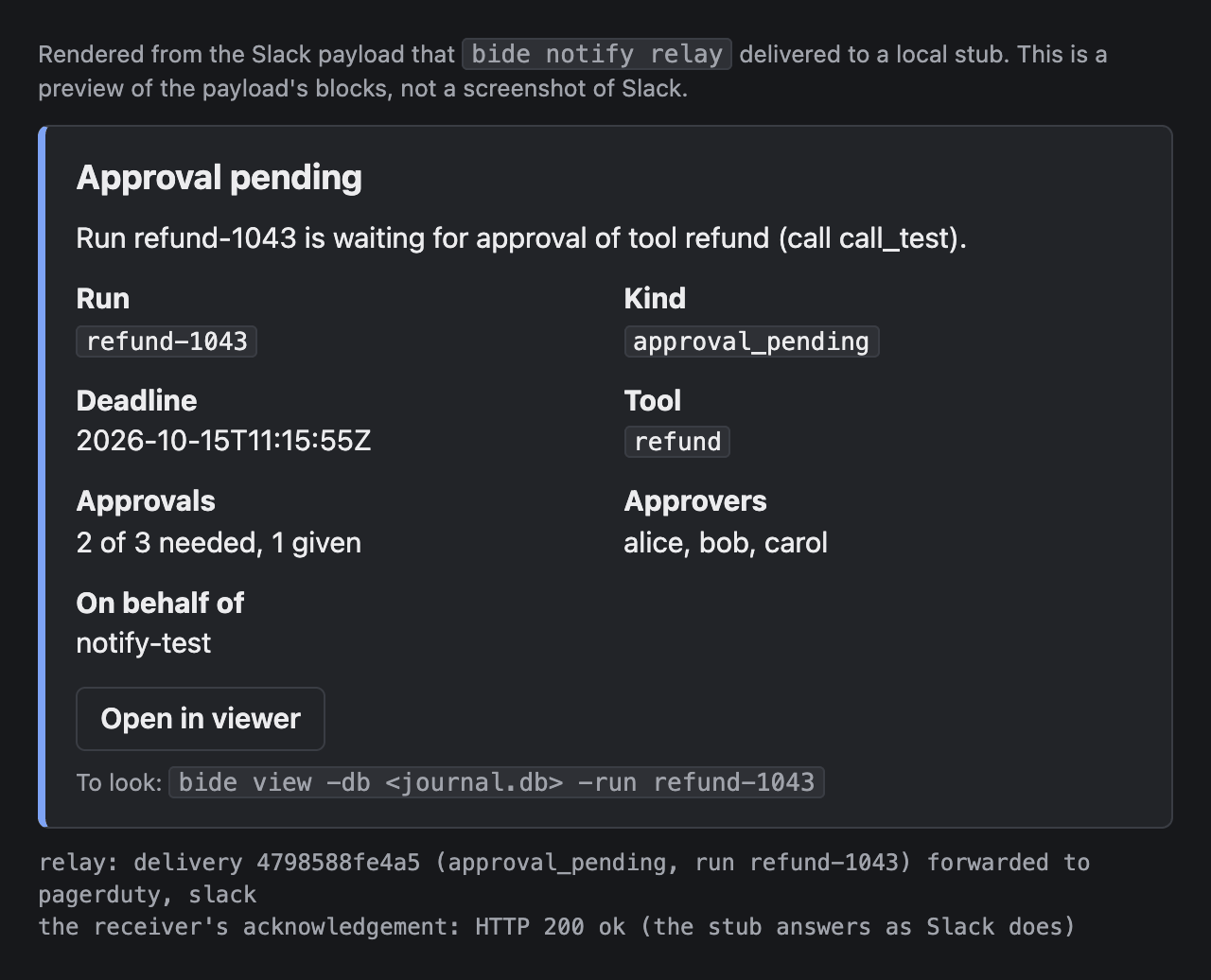
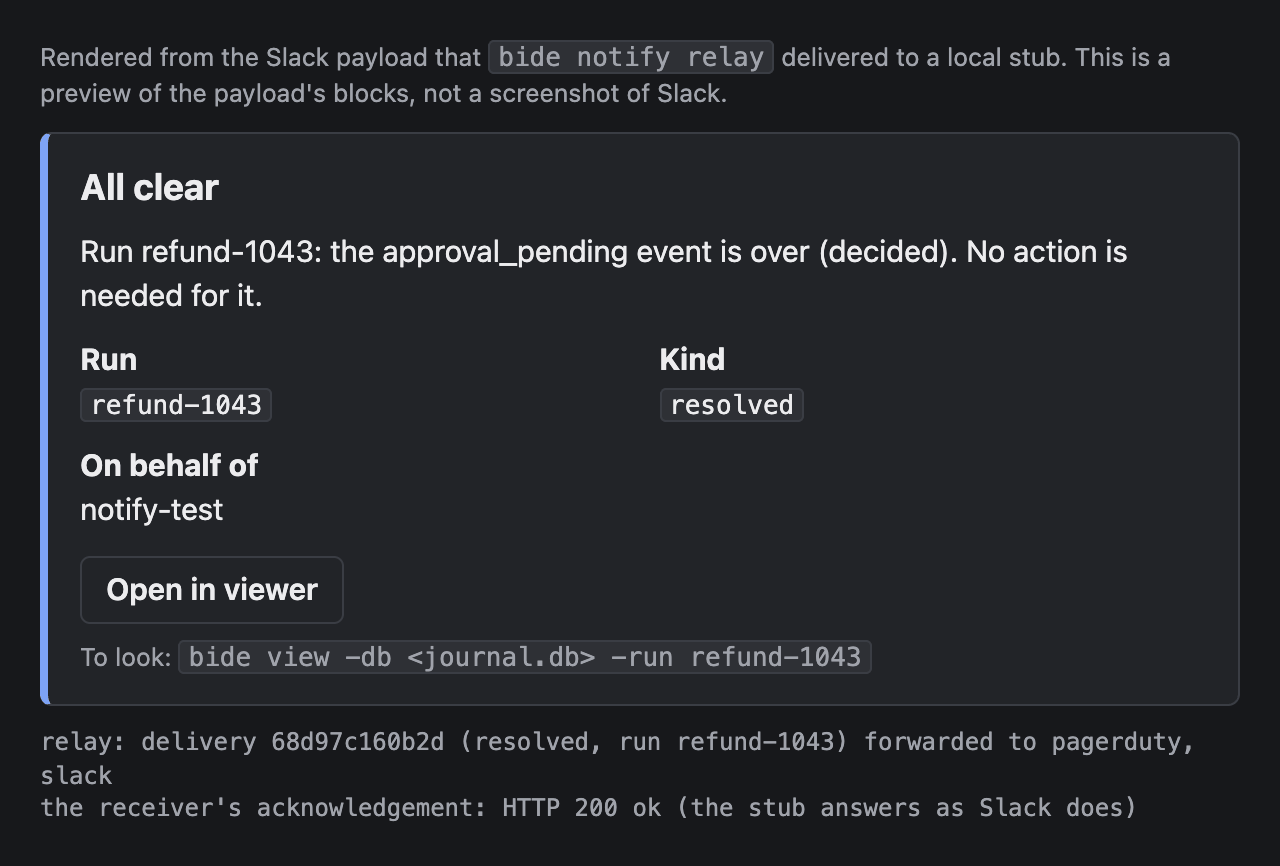
-kind picks the sample's kind (approval_pending by default; approval_expired, outcome_unknown, run_aborted, recovery_failing, notification_overdue, resolved, stop_set and stop_lifted too). To watch a relay open and close a PagerDuty incident, send -kind approval_pending -run notify-test-demo, then -kind resolved -run notify-test-demo: the resolved is the all-clear of that approval. -ca, -pin, -client-cert and -client-key are the receiver-side checks of the mutual TLS section; -view-url and -view-db shape the payload's view pointer as WithViewURL and WithViewDB do. What the relay sends Slack for a waiting approval, and its all-clear once the approval is decided, as a local stub received them (drawn from the Block Kit payloads the relay delivered; these are previews of the payloads, not screenshots of Slack):
Each test is a new event, so a receiver that drops redeliveries does not drop the second test. The sample is for a run called notify-test-<hex>, which does not exist: a relay forwards it like any other event, so a test against a relay posts a real message to Slack and opens a real PagerDuty incident. Use a test channel and a test service, and resolve the incident.
bide notify listen -client-ca <file> requires a client certificate, to try the -client-cert path; -cert and -key serve a certificate of your own instead of the generated one.
Slack and PagerDuty through the relay
Slack's incoming webhooks cannot check a signature, and PagerDuty wants its own event format, so neither can be the notifier's URL. bide notify relay is the small receiver between them:
export BIDE_WEBHOOK_SECRET=...                                   # the secret bide signs with
export SLACK_WEBHOOK_URL=https://hooks.slack.com/services/...    # a Slack incoming webhook
export PAGERDUTY_ROUTING_KEY=...                                 # an Events API v2 integration key
bide notify relay -addr :8443 -cert relay.crt -key relay.key -view-url https://bide.example.com/runs
and in your application, notify.NewWebhook("https://relay.example.com:8443/", notify.WithSecrets(...)). A destination is on when its variable is set (or its -slack-url-file, -pagerduty-key-file is named); the Slack URL and the routing key are credentials, read from the environment or a file, and never printed or logged. bide requires https for a receiver that is not on localhost, so give the relay -cert and -key, or terminate TLS in front of it.
For each request the relay verifies the signature, the timestamp and the signed delivery ID with notify.Verify, and answers 401 to anything else, for every kind of failure alike. Then:
- Slack gets a Block Kit message: a header naming what happened, the generated summary, the run, kind, deadline, the tool and who may approve, and an "Open in viewer" button when there is a link (the payload's
view.urlfromWithViewURL, else-view-urlplus the run ID). Everything that came from the run is escaped, so a run ID cannot open an@channelmention. - The all-clear (
resolved, see The all-clear) posts an "All clear" message to Slack and aresolveto PagerDuty with thededup_keyof the event it ends. If the clear reaches the relay first, the relay remembers the cleared ID and drops the event's trigger when it arrives. - PagerDuty gets an Events API v2
triggerwhosededup_keyis the event's notification ID (theidof the payload, the SHA-256 of the event key). It is the same on every delivery of the event, so PagerDuty folds repeats into one incident; a resolve names the same key. Severity follows the kind:outcome_unknownandnotification_overduearecritical,run_aborted,recovery_failingandapproval_expiredareerror,approval_pendingiswarning,stop_setiscriticalandstop_liftedisinfo.-pagerduty-urlpoints at the EU endpoint. - Error text and tool arguments are never forwarded, even if the sender allowed them with
WithFields: a message in a chat room or on a pager has left the access control the viewer applies.
At least once, and what the relay does about it. A relay that answered 204 before it had forwarded would lose the notification when Slack was down; so it answers 204 only after every destination took the event, and 502 when one did not, which makes bide retry the same event with the same ID. The retry can arrive when the first attempt had in fact succeeded (a lost reply), or when only one of two destinations failed, so the relay keeps the delivery IDs it has forwarded in a bounded memory cache (-dedupe, 10000 by default) and, per ID, which destinations took it. A repeat is acknowledged without forwarding again, and after a partial failure only the destination that failed is tried again. A duplicate that arrives while the first is still being forwarded gets 503, so bide retries rather than being told something that is not yet true. Forwarding keeps going if bide gives up waiting, so its retry finds the work done. Outbound calls have a 3 s timeout, up to 3 requests with a short backoff, and a total budget (-forward-timeout, 8 s) under bide's own 10 s request timeout.
A clear can reach the relay before the event it ends (the event was cleared while its request was failing, or its reply was lost). The relay remembers the IDs it has seen cleared, as many as -dedupe, and acknowledges a later notification of such an event without forwarding it, logging "dropped: already cleared"; otherwise that trigger would reopen an incident that is over.
By default the caches live in the process, and a restart empties them. Then a late redelivery is forwarded again, and so is a trigger that arrives after a clear: one that reached the relay before the restart reopens the PagerDuty incident its clear closed. The same happens when more than -dedupe other events came in between. That is a rare duplicate or stale message, never a lost one. PagerDuty absorbs a repeated trigger by its dedup_key; Slack shows a repeat twice.
-state <file> keeps both caches across restarts. The relay reads the file when it starts (a missing file is a first start; one it cannot parse is an error, so the memory is never silently empty) and rewrites it atomically (temporary file, fsync, rename, then an fsync of the directory on Unix; Windows cannot sync a directory, and the file's contents are synced before the rename), bounded by -dedupe like the caches. The whole file is rewritten, so a write costs more the larger -dedupe is: about 18 ms at 10000 entries on a laptop SSD (BenchmarkStateSave), mostly the sync. So writes are coalesced: a change to the forwarded-delivery set is written within -state-flush (1 s by default) together with whatever else changed by then, and Close writes what is pending. A clear is the exception, written at once, since a trigger after a crash is the failure the file prevents. A crash, as opposed to a clean stop, can therefore lose the forwarded-delivery entries of the last second: a redelivery of one of those events is forwarded once more, a repeat and never a lost notification. A negative -state-flush writes every change. It holds delivery IDs, cleared IDs and sink names, no payload and no secret. If a write fails the relay logs it and keeps forwarding, with its memory in the process as without the file, and retries the write until it works, so the state is not lost when the next event never comes. On Windows, where a reader holding the file open (a tail, a virus scan) refuses the replacing rename, the retries start within milliseconds (about 300 ms in all) and are not logged, and no request waits for them; any other failure is logged once and retried after the flush delay (at least a second), with the wait doubling to 30 seconds while it keeps failing, and the write that ends the streak is logged too. One file belongs to one relay: the relay holds an exclusive operating-system lock (<file>.lock, flock on Unix, LockFileEx on Windows) for as long as it runs, and a second relay on the same file refuses to start, naming it. The lock belongs to the process, so a relay that crashes or is killed releases it and the next one starts; there is no stale lock to delete. On a platform with no such lock (Solaris and AIX, where syscall.Flock does not exist; illumos has it) the relay refuses a StatePath at start (relay: locking the state file: exclusive file locks are not supported on this platform) instead of using the file unprotected; without a StatePath it runs, with its memory in the process. A save that is killed part way leaves the previous state file intact, and the next start removes the half-written temporary file. Two relays behind a load balancer still need a file each, and still have separate memories, so run one.
When Slack or PagerDuty refuses a forward, the relay's log names the sink, the HTTP status and, if the reply carries one, a short error token such as no_service or invalid event (Slack's or PagerDuty's error or status field, or a plain one-token body). It never logs the rest of the reply, which can echo the request.
Routes can point at different relays. A deployment that sends approvals to a Slack channel and halts to a pager runs two relays (or one per environment), each with its own secret, and gives each its own notify.NewWebhook URL as a receiver (see Routing and escalation); the relay needs nothing from the routing, and the escalated kind it forwards is a critical PagerDuty incident of its own (dedup key: the step's ID) that its all-clear closes.
Embed the relay
The CLI is a thin wrapper over package notify/relay, for a receiver you already run:
slack, err := relay.NewSlack(relay.SlackConfig{WebhookURL: slackURL, ViewURL: "https://bide.example.com/runs"})
if err != nil {
	return err
}
pd, err := relay.NewPagerDuty(relay.PagerDutyConfig{RoutingKey: routingKey})
if err != nil {
	return err
}
h, err := relay.New(relay.Config{Secrets: secrets, Sinks: []relay.Sink{slack, pd}})
if err != nil {
	return err
}
http.Handle("/bide", h) // verifies, dedupes by delivery ID, forwards, answers 204, 401 or 502
A relay.Sink is Name() string and Send(ctx, notify.Payload) error, so another destination (a different chat, an email gateway) is one type. relay.SlackMessage and relay.PagerDutyTrigger build the bodies without sending them. The PagerDuty sink resolves the incident of a resolved notification: relay.DefaultResolveTarget takes the clears.id of the payload, which is the dedup_key the event's trigger used, and PagerDutyConfig.ResolveTarget replaces it. A resolved payload with no clears names no incident and is ignored, not turned into a trigger.
The open trail, and upgrading a fleet
Besides a trail per run (notify:<run>), the notifier keeps one trail that belongs to no run, the open trail (notify:@open). It lists the events whose all-clear may still be owed: a record before an outcome_unknown, approval_pending or recovery_failing event is observed, and another when nothing more is owed for it. A sweep or a recovery pass reads it to find the runs that need a scan, including a run that has finished since, without reading every finished run. It is kept in one segment per UTC day (notify:@open:<date>) with a yearly index (notify:@open:index:<year>), so a read is bounded by what is listed now and not by history, and bide audit notifications checks that every delivered event of those kinds is listed on it. You do not configure it; with a signed trail (see Auditing) it is signed and anchored like the others.
A rolling upgrade is the one time that check can be wrong for a while. A process of the previous version delivers events without listing them on the open trail. A new-version scan of an unfinished run lists such an event at once; the backfill's second pass, no earlier than agent.WithNotifyUpgradeWindow (24 hours by default) after the first, lists what no scan reached (a run such a process saw through to its end). Set the window to the time your upgrade takes to reach every process, a week for a staged rollout across regions; it must be positive:
a, err := agent.New(model, journal, agent.WithNotifier(sink, trail,
	agent.WithNotifyUpgradeWindow(7*24*time.Hour), // a staged rollout across regions
))
An event that a previous-version process delivers after the second pass, in a run that ends before a new-version scan reaches it, stays unlisted, and bide audit notifications reports it. Until the window has passed, an audit during the upgrade may report an event as unlisted that the second pass will list; run it again after.
Where to look
A notification carries a view pointer, and the person who gets it opens the run viewer. bide view -db <journal.db> opens on the run list, whose headline links to the Needs attention list: every run that is waiting for approval, halted with an unknown outcome or aborted, newest first, with the approval's gate (who approved, who is pending, how long it has waited) or the halt's ResolveHalt call. Because the viewer reads the notification trail from the same database, each item also says whether it was notified and whether the sink acknowledged it, and a run whose recovery keeps failing is listed from the trail. That answers "did anyone hear about this?" in one place, and shows an item no notifier ever saw (no notification recorded) next to the ones that were delivered. See Needs attention.
Runnable example
examples/notify-routing (go run ./examples/notify-routing, no API key) builds the notifier of the routing section above over a refund waiting at a 2-of-2 gate and a charge halted on an unknown outcome, with the trail wrapped in audit.NewAuditedEventStore. In the first story every receiver answers: the approvals go to the risk and finance channels, the halt to on-call, the halt's resolution sends an all-clear, and audit.VerifyNotifications passes against the trail, the signed heads, the journals and agent.RoutingOf; then a copy of the trail with one record removed fails. In the second, on-call's endpoint is down: the lead is told after the step's deadline, and the audit reports that on-call's acknowledgement was late. Its test checks each of these.
What an acknowledgement means
The sink answering 2xx means your endpoint accepted the request, not that a person read it. The times in the trail are the notifying process's clock; anchor the trail's tree head with a timestamp to bound them from above.
Auditing: were the people told?
The trail is evidence, and bide audit notifications checks it offline against the run journals: that every event that needed a person (an unknown-outcome halt, an approval gate, an aborted run, a recovery failure, an overdue notice, an all-clear) was observed, delivered and acknowledged, and when. It fails (exit 1) on an event that was never notified, was acknowledged after its deadline (or after a bound you set with -max-ack), or is still overdue, and on a trail that was reordered, had a record deleted, or is not a history a notifier writes.
bide audit notifications -db run.db -sth notify-r1.sth.json -pubkey keys/log.pub
bide audit notifications -db run.db -pubkey keys/log.pub -max-unattested 10m $(for f in anchor/notify-r1-*.json; do echo -sth $f; done)
bide audit notifications -postgres-env BIDE_POSTGRES_DSN -unanchored -max-ack 10m
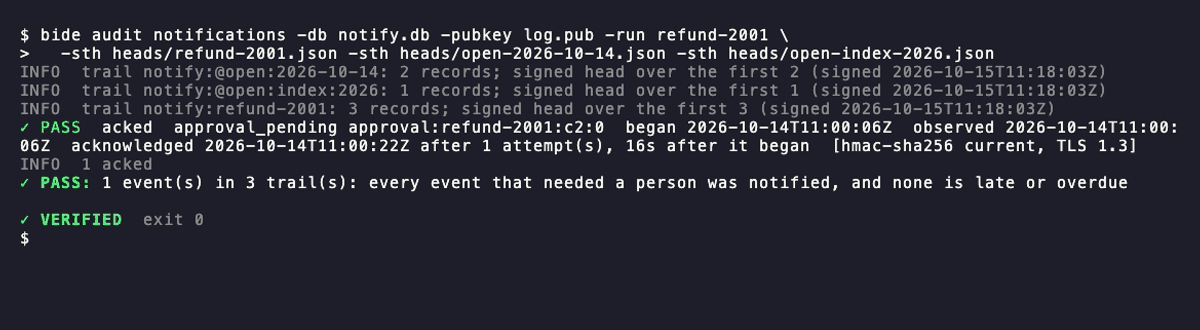
Run against a journal where one refund's waiting approval was delivered, acknowledged and covered by signed heads, it passes (exit 0):
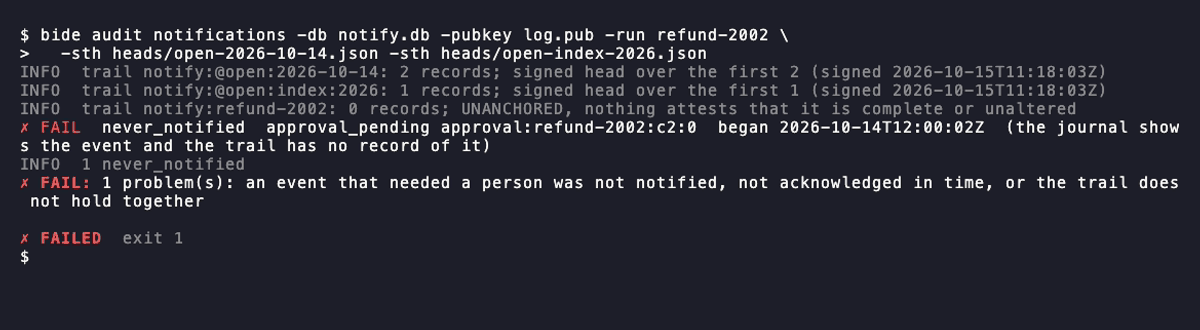
Against a run whose approval waits and which no notifier saw, it fails (exit 1) with never_notified:
The kill switch's stops are checked from the control run, with a store (-db, -postgres-env) and no -run (with -run the audit prints an INFO line that the stops were not checked): every stop in force must have been told (stop_set, never_notified if it was not), whatever its recorded time says, because that time is its writer's own. A stop that is lifted owes its all-clear and its stop_lifted; -stops-within (default 7 days, the notifier's WithNotifyStopsWithin) limits only stops that are over, and a stop set and lifted before any notifier looked owes only the lift. A control run record dated in the future, or more than five minutes before an earlier record, is a problem of its own. The stops are read as the deployment's mode judges them: give -stop-policy (and -stop-root) for an audited deployment; without it a control run that holds signed records is refused (exit 4), because the audit could not read it and would pass what it did not check. See the kill switch guide.
Two things to set up on your side:
Sign and anchor the trail. Wrap the event store the trail lives in with an
audit.AuditedEventStore, and the notifier's trail is signed and anchored as it is written, with the sameaudit.Signerandaudit.Anchoras a journal (audit.NewAuditedStore), so an HSM or KMS signer and an external transparency log work unchanged:goaudited, _ := audit.NewAuditedEventStore(evStore, signer, anchor) audited.OnError(func(trail string, err error) { log.Printf("anchoring %s: %v", trail, err) }) trail := audit.NewNotifyTrail(audited) opt := agent.WithNotifier(sink, trail) // the trail is signed as it is writtenEach growth of a run's trail (
notify:<run>) publishes a signed tree head (kindevents, run ID the trail's name, the headaudit.SignNotifyTrailsigns) from a background publisher, so the anchor, the signer and the clock are never on the delivery path: a slow or hung anchor cannot lengthen a round, and a failure to publish never fails or delays a delivery (it goes toOnError). One attempt is abandoned afterWithTimeout(default 3 seconds) even if the anchor ignores its context, and after a failure the store pauses forWithCooldown(default 30 seconds) and then probes, so an outage costs one timeout per cooldown. What an outage or a crash left unsigned is signed again byNotifyPending,RecoverLoop,RecoverandFlushNotifications, for the runs they look at and for any trail an earlier attempt failed, andReanchor,ReanchorPendingandFlushdo it on demand. The window left open is therefore the publisher's delay when the anchor is healthy, and the outage plus the time to the next sweep when it is not. The wrapper signs every trail written through it, so the trails that belong to no run are covered as well: the digest's, the open trail's daily segments (notify:@open:<date>) and its yearly index (notify:@open:index:<year>); a sweep and, once a minute, a recovery pass sign again the digest, the index, today's segment and the newest three. CallFlush(orFlushNotifications) before the process exits.A trail with no head is reported
UNANCHORED, and whoever can write the event store could have changed it undetected; with heads, a deleted, reordered or changed record is found. Give the verifier every head the anchor holds for a trail (-sth, once per head): each must verify and match a prefix of the trail, and the largest is the newest. Records after the newest head are read but not attested; the report says how many there are and how long the oldest has gone unattested, and-max-unattestedfails a gap older than the bound you set, which is how you check the anchoring is keeping up. An event whose ack, clearing or observation is only in that tail isunattestedand fails; a nonzero-max-unattestedaccepts it when its tail records are that recent, without a signature, so their content and times are trusted (default 0: strict). Add-routing routing.json(fromagent.RoutingOfwith the notifier's options) to require a delivery to each receiver an event routes to and to each due escalation step; without it that is not checked.audit.SignNotifyTrailremains for signing a head by hand. The head attests the trail, not who may sign: keep the signing key where the application cannot use it freely (an HSM or KMS signer), or an attacker who controls the process can sign a rewritten trail.Give it the journals. The check of the trail alone cannot find a halt or a gate that no notifier ever saw; the cross-check against the journals can.
-dband-postgres-envread both from the store, read-only (the Postgres DSN is read from the named environment variable, never given on the command line). From exported files, pass-trailand-journalfor each run.
With routing, every verdict names the receiver (and the level of an escalation step), -json carries them, and the text report adds a line per receiver: whether each receiver was told is its own acked. The checks include the escalation chain: a step is valid only if it is after its deadline, in order, and for an event not yet acknowledged or cleared. The audit cannot see the configuration, so it cannot say that an event should have been routed or escalated; see known limitations.
The report gives each event its times (when the run entered the state, when the notifier saw it, when the sink acknowledged it), the attempts, and how the delivery was authenticated. See Audit: notification evidence for the checks, the statuses and what the check cannot see. It proves the sink accepted the request, not that a person read it.